
Luister gratis naar deze podcast in de app: Gratis downloaden in de App Store
radio.net
Slaaptimer
Favorieten opslaan
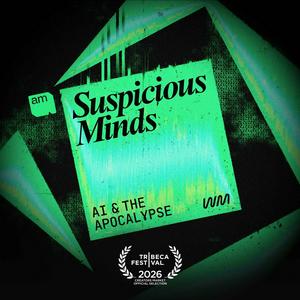
Suspicious Minds: AI and the Apocalypse
Agoric Media
Nieuwste aflevering
34 afleveringen
An Enormous Mistake (Part Three)
22-10-2026 | 1 u. 7 Min.Near a reservoir north of San Diego, two empires of Argentine ants have been at war every day for more than twenty years. Thirty million of them die a year. They have no idea we exist. So I keep wondering: is there something that looks at us the way we look at them, and could we be building it?
Part Three of our effective altruism, longtermism, and Dark Enlightenment trilogy follows the longtermist train of thought somewhere strange. In 2012 a British philosopher named Nick Land published the essays that gave the Dark Enlightenment its name. His best idea is hyperstition, a fiction that makes itself true by being believed. His wildest is that capitalism is an intelligence assembling itself through us, with AI being the end result. Land’s essays leaned on a blog by a software engineer named Curtis Yarvin, writing as Mencius Moldbug, who popularized the ‘red pill’ as a political awakening and proposed replacing the nation-state with sovereign territories run like companies.
Yarvin talked to me for nearly three hours from a parked car in the sun with his laptop overheating. I brought our frequent contributors’ critiques to him one by one: Emily Ray’s “who loses,” in a collapse, Robert Kirsch’s GovCorp, Ed Simon’s pondering whether Yarvin ends up being seen as “Rasputin or a footnote.” He explains why a country should be run like Apple, what a king does when a hurricane hits, why he thinks AI doom is the oldest story humans tell, and what an Elizabethan economist knew that we’ve long since forgotten. His critics get their say, and so does he.
Also included: rationalism, LessWrong, and Roko’s Basilisk, the thought experiment that was taken down for being too dangerous to read. Malo Bourgon of MIRI tells the story, and I tell you about the hell I grew up afraid of. Then Timothy Morton on why meaning comes from the future, and at the very end, Donald Rumsfeld, Joel Gold, and the can’t-be-knowns.
COMING SOON, A BONUS EPISODE: “Moral Luck.” Philosopher Richard Yetter Chappell on why effective altruism isn’t utilitarianism, the difference between consequentialism and “naive instrumentalism” (rob a bank, give the money to charity), the thought experiments philosophers keep on hand, and what happens when one of them walks out of the classroom and into a courtroom. Plus the contrarian take on Sam Bankman-Fried I promised you, whether FTX customers got their money back, and the name philosophers have for the discomfort that follows. It didn’t fit in this episode, but it was too good to stay on the cutting room floor.
Next episode: our first ever Halloween episode. Mary Shelley, The Last Man, the original post-apocalyptic novel, and of course Frankenstein. I can’t promise it won’t be spooky.
We hope you enjoy this episode of our second season of Suspicious Minds. Be sure to follow here, and subscribe to our newsletter for updates: https://agoricmedia.substack.com
Many of our full long-form expert interviews are available ad-free on Patreon. Hear complete conversations with our guests: https://www.patreon.com/cw/AgoricMedia
A Wondermind and Agoric Media Production
Agoric Media
https://www.instagram.com/agoricmedia/
https://www.youtube.com/@agoricmedia
https://www.tiktok.com/@agoricmedia
https://agoricmedia.substack.com/
https://www.agoricmedia.com
Wondermind
https://www.instagram.com/officialwondermind/
https://www.wondermind.com/
Host and Creator: Sean King O'Grady
https://www.instagram.com/seankingogrady/
https://seankingogrady.substack.com/
Guests:
Curtis Yarvin — Writer, Gray Mirror; founder, Urbit — https://graymirror.substack.com
Richard Yetter Chappell — Professor of Philosophy, University of Miami / Author of the blog Good Thoughts — https://www.goodthoughts.blog/
Robert Kirsch - assistant professor in the School of Applied Professional Studies at Arizona State University / Co-author, Be Prepared: Doomsday Prepping in the United States — https://amzn.to/3SzUnwB
Emily Ray - associate professor of political science at Sonoma State University / Co-author, Be Prepared: Doomsday Prepping in the United States — https://amzn.to/3SzUnwB
Ed Simon - Carnegie Mellon University - The Dove and the Dragon: A Cultural History of the Apocalypse - https://amzn.to/4dVMYQb
Malo Bourgon — CEO, Machine Intelligence Research Institute — https://intelligence.org
Dan Faggella — CEO and Head of Research, Emerj Artificial Intelligence Research — https://emerj.com
Timothy Morton — Rita Shea Guffey Chair in English, Rice University / Author, Hyperobjects — https://amzn.to/4xPqGa4
Dr. Joel Gold - Assistant Clinical Professor of Psychiatry, Icahn School of Medicine at Mount Sinai, and co-author of Suspicious Minds: How Culture Shapes Madness: https://amzn.to/4upyA8U
Other works and things mentioned:
ON THE ANTS
Sunamura et al., “Intercontinental union of Argentine ants: behavioral relationships among introduced populations in Europe, North America, and Asia,” Insectes Sociaux (2009) — https://link.springer.com/article/10.1007/s00040-009-0001-9
van Wilgenburg, Torres and Tsutsui, “The global expansion of a single ant supercolony,” Evolutionary Applications (2010) — https://pmc.ncbi.nlm.nih.gov/articles/PMC3352483/
“The Sun Never Sets on the Ant Empire,” Saltman Quarterly, UC San Diego (2019) — https://sqonline.ucsd.edu/2019/05/the-sun-never-sets-on-the-ant-empire/
“The strange and turbulent global world of ant geopolitics,” Aeon — https://aeon.co/essays/the-strange-and-turbulent-global-world-of-ant-geopolitics
ON THE DARK ENLIGHTENMENT
Nick Land, “The Dark Enlightenment” (2012) — https://fluidself.org/books/philosophy/the-dark-enlightenment
Nick Land, “Meltdown” (1994), collected in Fanged Noumena: Collected Writings 1987–2007 (Urbanomic, 2011) — https://link.amazon/B0fNYO378
Curtis Yarvin (as Mencius Moldbug), “The Case Against Democracy: Ten Red Pills,” Unqualified Reservations (April 2007) — https://www.unqualified-reservations.org/2007/04/case-against-democracy-ten-red-pills/
Curtis Yarvin (as Mencius Moldbug), “Patchwork: A Political System for the 21st Century,” Unqualified Reservations (2008) — https://www.unqualified-reservations.org/pdfs/patchwork.pdf
Unqualified Reservations, the full archive — https://www.unqualified-reservations.org/
Curtis Yarvin, “How the USG should respond to AI,” Gray Mirror (September 16, 2026) — https://graymirror.substack.com/p/how-the-usg-should-respond-to-ai
ON HYPERSTITION (sort of):
William Gibson, “Neuromancer” - https://link.amazon/B0e9N8llv
PRESS ON YARVIN
James Pogue, “Inside the New Right, Where Peter Thiel Is Placing His Biggest Bets,” Vanity Fair (April 20, 2022) — https://www.vanityfair.com/news/2022/04/inside-the-new-right-where-peter-thiel-is-placing-his-biggest-bets
Ava Kofman, “Curtis Yarvin’s Plot Against America,” The New Yorker (published online June 2, 2025; issue dated June 9, 2025) — https://www.newyorker.com/magazine/2025/06/09/curtis-yarvin-profile
David Marchese, “Curtis Yarvin Says Democracy Is Done. Powerful Conservatives Are Listening,” The New York Times Magazine / The Interview (January 18, 2025) — https://www.nytimes.com/2025/01/18/magazine/curtis-yarvin-interview.html
ALSO IN THE YARVIN SECTION
Alexander Pope, An Essay on Man (1733–34): “For forms of government let fools contest; / Whate’er is best administer’d is best.” (Yarvin paraphrases it on air.)
Karel Čapek, R.U.R. (Rossum’s Universal Robots), 1920 — the play that gave us the word “robot.”
Aron Simanovich, Rasputin and the Jews: A Reminiscence — the memoir of Rasputin’s jeweler-turned-secretary –
The Elizabethan “fish days”: the 1563 statute adding Wednesday as a fish day to support the fleet — https://www.tandfonline.com/doi/full/10.1080/00253359.2024.2331917#d1e151
Elon Musk on humanity as “the biological bootloader for digital superintelligence” — https://x.com/elonmusk/status/1783959488481161491
ON THE BASILISK
Roko’s Basilisk — the original 2010 LessWrong post and its removal. Context: David Auerbach, “Roko’s Basilisk: The most terrifying thought experiment of all time,” Slate (July 2014) — https://slate.com/technology/2014/07/rokos-basilisk-the-most-terrifying-thought-experiment-of-all-time.html
Nick Bostrom, “Information Hazards: A Typology of Potential Harms from Knowledge,” Review of Contemporary Philosophy (2011) — https://nickbostrom.com/information-hazards.pdf
David Langford, “BLIT,” Interzone (1988); “comp.basilisk FAQ,” Nature (1999); “Different Kinds of Darkness” (2000) — https://ansible.uk/writing/c-b-faq.html and https://www.infinityplus.co.uk/stories/blit.htm
Pascal’s wager — Stanford Encyclopedia of Philosophy — https://plato.stanford.edu/entries/pascal-wager/
If Anyone Builds It, Everyone Dies by Eliezer Yudkowsky and Nate Soares: https://amzn.to/49gpPW1
ALSO MENTIONED
Donald Rumsfeld, Department of Defense news briefing, February 12, 2002 (“known knowns”) — https://en.wikipedia.org/wiki/There_are_unknown_unknowns
Errol Morris, The Unknown Known (2013), the Rumsfeld documentary — https://en.wikipedia.org/wiki/The_Unknown_Known
As an Amazon Associate, we earn from qualifying purchases. By buying our guests’ books through these links, you’re supporting this series too.
This episode was made by:
Executive Producers: Mandy Teefey, Selena Gomez, Jonathon Glucksman, Molly Borman, Jesse Ford, David Tuohy, Feras M. Shammami
Produced by: Jesse Ford
Editor: David Justin Martin
Original Music: Shane Patrick Ford
Sound Mix: Mike Regan and Paul Bennett
Graphics: Semi:Formal
Film/TV PR: Emma Griffiths PR
Podcast PR: Tink Media (Shreya Sharma and Holly Brown)
Wondermind Chief of Staff: Emma Wright
Additional Camera and Audio: Tyler Copenhaver, Backlot Studios, Elliot Uriah
See Privacy Policy at https://art19.com/privacy and California Privacy Notice at https://art19.com/privacy#do-not-sell-my-info.Moral Insurance (Part Two)
14-10-2026 | 56 Min.The Secretary of War called it “defective altruism.” The New York Post called it a cult. The Economist put it on the cover and called it the most important social movement of the century. Hardly anyone in America has heard of it. So for this episode I did what I should have done before Part One: I sat down with an effective altruist.
Richard Yetter Chappell is a philosophy professor at the University of Miami and the author of the blog Good Thoughts. He’d heard what our critics said last week, and he came ready to answer them: the charge that these are pro-extinctionist movements, “suffering now, paradise later,” and whether caring about future people means caring less about the people in front of you. Then the math also takes us somewhere strange, with a writer who argues that the welfare of insects outweighs the welfare of humans.
We ask Richard the tough question: is effective altruism a cult? Then we follow the money. Émile Torres names the billionaires. Malo Bourgon of MIRI tells me who actually funds him. Ed Simon says the whole thing is a way of never changing anything. And I put the Bill Gates problem to Richard: taxed and spent democratically, or Gates decides?
Also: that time our ancestors nearly went extinct, Pulvermacher’s electric chain and the Singularity Summit I should have attended.
We hope you enjoy this episode of our second season of Suspicious Minds. Be sure to follow here, and subscribe to our newsletter for updates: https://agoricmedia.substack.com
Many of our full long-form expert interviews are available ad-free on Patreon. Hear complete conversations with our guests: https://www.patreon.com/cw/AgoricMedia
A Wondermind and Agoric Media Production
Agoric Media
https://www.instagram.com/agoricmedia/
https://www.youtube.com/@agoricmedia
https://www.tiktok.com/@agoricmedia
https://agoricmedia.substack.com/
https://www.agoricmedia.com
Wondermind
https://www.instagram.com/officialwondermind/
https://www.wondermind.com/
Host and Creator: Sean King O'Grady
https://www.instagram.com/seankingogrady/
https://seankingogrady.substack.com/
Guests:
Richard Yetter Chappell — Professor of Philosophy, University of Miami / Author of the blog Good Thoughts — https://www.goodthoughts.blog/
Émile Torres — Philosopher and historian of science / Author, Human Extinction: A History of the Science and Ethics of Annihilation — https://www.realtimetechpocalypse.com/
Ed Simon — Writer, cultural critic, and professor at Carnegie Mellon / Author, The Dove and the Dragon: A Cultural History of the Apocalypse — https://amzn.to/4dVMYQb
Malo Bourgon — CEO, Machine Intelligence Research Institute — https://intelligence.org
Other works and things mentioned:
Pete Hegseth, the Pentagon and Anthropic (Feb 2026) — NPR/WBUR report: https://www.wbur.org/npr/nx-s1-5725327/pentagon-anthropic-hegseth-safety
The New York Post on effective altruism and newsrooms (Sept 2026), drawing on Semafor's Dec 2025 report on the Tarbell Center — https://nypost.com/2026/05/14/media/cult-like-effective-altruism-spreading-its-message-among-the-influential-with-80-journalists-embedded-at-top-news-orgs/
The Nation, David Futrelle on effective altruism (Sept 23, 2026) — https://www.thenation.com/article/society/effective-altruism-trump-ai/
The Economist cover story on effective altruism (early Oct 2026; syndicated as "Effective altruism conquered the world, and may yet end it") — https://www.economist.com/leaders/2026/10/01/effective-altruism-is-this-centurys-biggest-idea
Rethink Priorities, how many Americans have heard of effective altruism (2022) — https://rethinkpriorities.org/research-area/how-many-people-have-heard-of-effective-altruism/
On the ideas:
Hu et al., "Genomic inference of a severe human bottleneck during the Early to Middle Pleistocene transition," Science (Aug 31, 2023) — https://www.science.org/doi/10.1126/science.abq7487
Bentham's Bulldog, the insects post (Substack, Sept 2026) — newsletter: https://benthams.substack.com/p/insects-matter-more-than-people
Richard Yetter Chappell, "Babies, Bathwater, and Effective Altruism" (Good Thoughts) — https://www.goodthoughts.blog/p/babies-bathwater-and-effective-altruism
Jeremy Bentham on animals, "Can they suffer?" — https://1000wordphilosophy.com/2022/03/18/bentham-on-animals/
Jeremy Bentham's auto-icon, UCL — https://www.ucl.ac.uk/bentham-project/who-was-jeremy-bentham/auto-icon
Pulvermacher's chain, Science Museum Group collection — https://collection.sciencemuseumgroup.org.uk/objects/co136729
On the cult question:
The EA Forum (where the movement argues with itself in public) — https://forum.effectivealtruism.org
Time, Charlotte Alter (Feb 2023), on women's accounts of sexual harassment in parts of the EA community — https://time.com/6252617/effective-altruism-sexual-harassment/
The Centre for Effective Altruism's response — https://forum.effectivealtruism.org/posts/XxXnPoGQ2eKsQx3FE/cea-s-response-to-sexual-harassment
Effective Ventures UK board statement on the resignation — https://forum.effectivealtruism.org/posts/9JCkkjKMNL4Hmg4qP/ev-uk-board-statement-on-owen-s-resignation
Effective Ventures' investigation and its findings — https://forum.effectivealtruism.org/posts/4CBoJ5jgmGfdMFnAE/ev-investigation-into-owen-and-community-health
On the money:
Time, "Effective Altruist Leaders Were Repeatedly Warned About Sam Bankman-Fried Years Before FTX Collapsed" (Charlotte Alter, March 2023) — https://time.com/6262810/sam-bankman-fried-effective-altruism-alameda-ftx/
EA Forum discussion of it: https://forum.effectivealtruism.org/posts/b83Zkz4amoaQC5Hpd/time-article-discussion-effective-altruist-leaders-were)
The Singularity Summit (2006–2012) – https://en.wikipedia.org/wiki/Singularity_Summit
The AI super PACs: "The AI influence network's power players," Axios (Feb 27, 2026) — https://www.axios.com/2026/02/27/ai-influence-power-players ·
"Anthropic Puts $20 Million Into a Super PAC Operation to Counter OpenAI," Election Law Blog — https://electionlawblog.org/2026/anthropic-puts-20-million-into-a-super-pac-operation-to-counter-openai/
Fredric Jameson, "It is easier to imagine the end of the world than the end of capitalism" — https://newleftreview.org/issues/ii21/articles/fredric-jameson-future-city
On the good it's done:
Scott Alexander, "In Continued Defense of Effective Altruism" (Astral Codex Ten, 2023) — https://www.astralcodexten.com/p/in-continued-defense-of-effective
GiveDirectly — https://www.givedirectly.org
Also mentioned:
Eliezer Yudkowsky and Nate Soares, If Anyone Builds It, Everyone Dies (2025) — https://amzn.to/49gpPW1
Margaret Wertheim, The Pearly Gates of Cyberspace: A History of Space from Dante to the Internet (1999), recommended by listener Corey Perla — https://link.amazon/B0c9FUtS7
As an Amazon Associate, we earn from qualifying purchases. By buying our guests’ books through these links, you’re supporting this series too.
Credits:
Executive Producers: Mandy Teefey, Selena Gomez, Jonathon Glucksman, Molly Borman, Jesse Ford, David Tuohy, Feras M. Shammami
Produced by: Jesse Ford
Editor: David Justin Martin
Original Music: Shane Patrick Ford
Sound Mix: Mike Regan and Paul Bennett
Graphics: Semi:Formal
Film/TV PR: Emma Griffiths PR
Podcast PR: Tink Media (Shreya Sharma)
Wondermind Chief of Staff: Emma Wright
Additional Camera and Audio: Tyler Copenhaver, Backlot Studios
Special Thanks: Caitlin Yardley, Mike Levine, Our Listener with Concerns about the Last Episode
See Privacy Policy at https://art19.com/privacy and California Privacy Notice at https://art19.com/privacy#do-not-sell-my-info.Better Angels (Part One)
07-10-2026 | 1 u. 10 Min.Content note: this episode includes discussion of eugenics, Nazi forced sterilization and the murder of disabled people, and the Holocaust.
Be altruistic. Think about the future. Save the world. No one could possibly object to that, right?
This week, the first of two episodes on effective altruism, a philosophy that has influenced many of the most powerful people in artificial intelligence, one its defenders believe is among the best ideas we have for doing good, and one that other thinkers believe could help bring about the end of the world.
For three episodes we asked which minds count. Now we ask whose future counts: the people here today, the trillions who don’t exist yet, or digital beings we (probably) haven’t yet built? And I’ve started to think the best way to understand these ideas isn’t as philosophies at all. It’s as eschatologies.
Philosopher Émile Torres grew up in a Baptist household waiting for the Rapture, and describes how the study of existential risk filled the “eschatology-shaped hole” left behind when they lost their faith, and argues that the promise of a cosmic utopia is how the people building AI justify the harm it’s causing now. Writer Ed Simon places EA in the tradition of Bentham and Mill. Journalist Dorian Lynskey, author of Everything Must Go, on the radical empathy that first drew him to it, and how it turned toward longtermism and Sam Bankman-Fried. Philosopher Dr. Marcus Arvan asks whether “doing the most good” is even a coherent idea, and whether human beings are capable of real altruism at all.
Then Simone and Malcolm Collins, the pronatalist authors and podcasters who believe effective altruism hasn’t gone far enough. They call it Hard EA. We talk about why they believe future people matter as much as anyone alive today, why demographic collapse scares them more than anything on the Doomsday Clock, and the question nearly everyone asked me when I said I was interviewing them: aren’t they eugenicists?
Also: Dune and the Litany Against Fear, the Butlerian Jihad, mosquito nets (so many mosquito nets), the Rapture, polygenic embryo screening, what Claude made of the Collinses’ book, Peter Thiel and the Antichrist, Gurren Lagann, Pantheon (again), and how any of us survive Thanksgiving.
Everyone in this story thinks they’re saving the future. That’s what makes it so hard to talk about, and so important. And if you’re part of the effective altruism community and think we got something wrong: GET AHOLD OF US. We want to hear from you.
Next week, Part Two: The Dark Enlightenment. We follow the other branch of the fork, to the people for whom the end of the world isn’t something to prevent, but a doorway.
We hope you enjoy this episode of our second season of Suspicious Minds. Be sure to follow here, and subscribe to our newsletter for updates: https://agoricmedia.substack.com
Our full long-form expert interviews are available ad-free on Patreon. Hear complete conversations with Dr. Amy Levy, Émile Torres, Dr. Joel Gold and Ian Gold, PhD., and more: https://www.patreon.com/cw/AgoricMedia
A Wondermind and Agoric Media Production
Agoric Media
https://www.instagram.com/agoricmedia/
https://www.youtube.com/@agoricmedia
https://www.tiktok.com/@agoricmedia
https://agoricmedia.substack.com/
www.agoricmedia.com
Wondermind
https://www.instagram.com/officialwondermind/
https://www.wondermind.com/
Host and Creator: Sean King O’Grady
https://www.instagram.com/seankingogrady/
https://seankingogrady.substack.com/
Guests:
Émile Torres — Philosopher and historian of science / Author, Human Extinction: A History of the Science and Ethics of Annihilation — https://www.realtimetechpocalypse.com/
Ed Simon — Writer, cultural critic, and professor at Carnegie Mellon / Author, The Dove and the Dragon: A Cultural History of the Apocalypse — https://amzn.to/4dVMYQb
Dorian Lynskey — Journalist / Author, Everything Must Go: The Stories We Tell About the End of the World — https://amzn.to/42ISDD1
Dr. Marcus Arvan — Chair and Professor of Philosophy, University of Tampa — Author, Neurofunctional Prudence and Morality — https://link.amazon/B05vK59aa
Simone and Malcolm Collins — Authors and podcasters / Authors, The Pragmatist’s Guide to Crafting Religion — https://link.amazon/B00hVgEeO
Other works and things mentioned:
Frank Herbert, Dune (1965), the Litany Against Fear and the Butlerian Jihad — https://link.amazon/B09GICw7g
Utilitarianism: Jeremy Bentham and John Stuart Mill — https://plato.stanford.edu/entries/utilitarianism-history/
Effective altruism and longtermism: Toby Ord: The Precipice – https://link.amazon/B0cDl0lZj
William MacAskill — What We Owe the Future – https://amzn.to/4fqeepB
Émile Torres & Timnit Gebru, “The TESCREAL Bundle: Eugenics and the Promise of Utopia through Artificial General Intelligence” (First Monday) — https://firstmonday.org/ojs/index.php/fm/article/view/13636
Dispensationalism and the Rapture — https://www.britannica.com/topic/dispensationalism
Sam Bankman-Fried and the collapse of FTX — https://en.wikipedia.org/wiki/Sam_Bankman-Fried
The Doomsday Clock, Bulletin of the Atomic Scientists, 2026 statement — https://thebulletin.org/doomsday-clock/2026-statement/
Polygenic embryo screening: American College of Medical Genetics and Genomics statement on polygenic risk scores for embryo selection — https://pubmed.ncbi.nlm.nih.gov/38393332/
The Nazi “euthanasia” program — United States Holocaust Memorial Museum — https://encyclopedia.ushmm.org/content/en/article/euthanasia-program
The Man in the High Castle (Prime Video) — https://www.primevideo.com/detail/0MJFK5BDOS4K13C3WBUIB7NY98?ref_=atv_dp_share_cu_r
Gurren Lagann — https://en.wikipedia.org/wiki/Gurren_Lagann
Pantheon — https://youtu.be/wTgYeETwgKQ
Peter Thiel’s lectures on the Antichrist — https://www.washingtonpost.com/technology/2025/10/10/peter-thiel-antichrist-lectures-leaked/
The Most Human Human — our TESCREAL story with Émile Torres — https://podcasts.apple.com/us/podcast/suspicious-minds-ai-and-the-apocalypse/id1844631307?i=1000777856826
Dreaming Machines – our John West episode, on friction and the frictionless society — https://podcasts.apple.com/us/podcast/suspicious-minds-ai-and-the-apocalypse/id1844631307?i=1000788829733
A Great Loss to the Universe (Part Three) — last week’s episode, with David Benatar — https://podcasts.apple.com/us/podcast/suspicious-minds-ai-and-the-apocalypse/id1844631307?i=1000792369838
Suspicious Minds: AI and Psychosis (Season 1) — https://podcasts.apple.com/us/podcast/suspicious-minds-ai-and-psychosis/id1844631307
As an Amazon Associate, we earn from qualifying purchases. By buying our guests’ books through these links, you’re supporting this series too.
Credits:
Executive Producers: Mandy Teefey, Selena Gomez, Jonathon Glucksman, Molly Borman, Jesse Ford, David Tuohy, Feras M. Shammami
Produced by: Jesse Ford
Editor: David Justin Martin
Original Music: Shane Patrick Ford
Sound Mix: Mike Regan and Paul Bennett
Graphics: Semi:Formal
Film/TV PR: Emma Griffiths PR
Podcast PR: Tink Media (Shreya Sharma)
Wondermind Chief of Staff: Emma Wright
Additional Camera and Audio: Tyler Copenhaver, Backlot Studios
See Privacy Policy at https://art19.com/privacy and California Privacy Notice at https://art19.com/privacy#do-not-sell-my-info.A Great Loss to the Universe (Part Three)
30-09-2026 | 1 u. 13 Min.Content note: this episode includes a brief discussion of suicide. If you or someone you know is struggling, call or text 988 to reach the 988 Suicide & Crisis Lifeline in the US. Outside the US, you can find a local helpline at https://findahelpline.com.
Neuropsychoanalysis pioneer Mark Solms says he is building a machine that can feel. For two episodes, we asked whether he can. This week we ask whether he should.
This is the final part of our three-part story about consciousness. Philosopher Ian Gold, PhD explains why AI has turned philosophy of mind from science fiction into decisions we actually have to make, and why moments like this only come along when science forces philosophy's hand. His brother, psychiatrist Dr. Joel Gold, the other co-author of Suspicious Minds, makes a few cases I didn't see coming: that psychoanalysis doesn't need to be a science, and that projects like Mark's don't need to exist at all. Ian disagrees. The problem, he says, is never science. It's people.
Then a pattern I only noticed after the fact: almost every time I asked someone about creating a mind, they started talking about children. Philosopher Marcus Arvan speaks with us about what it means to experiment on a being that might be able to suffer. Psychoanalyst Dr. Amy Levy explores why we call some of the things we make "artificial," and others "home."
And David Benatar, the anti-natalist philosopher who believes that bringing any sentient being into existence is a harm, joins a conversation that has in many ways been about him. Mark Solms remembers David challenging him at his book launch in Cape Town, and tells us why he believes creating a conscious being is a mitzvah. David responds directly, to Mark, to Hon Weng Chong, and to Ian Gold, who calls him a utilitarian. He isn't one, he says, and he explains why so many people think he is.
Also: Kant's answer to Newton, John Searle's Chinese Room, what it's like to be a bat, Karl Popper and the black swan, Dr. Michael Ferguson on whether a machine could be spiritual, Peter Singer and Moby's forearms, Master Yoda's emotional family tree, a toddler and an ant farm, and the German word for worldview.
Everyone in this episode is asking “whether” a new form of consciousness can or should be created. Amy Levy was the only one who answered a different question: what would we actually do the morning after it is?
A Great Loss to the Universe concludes a three-part investigation into consciousness that began with The Problem of Other Minds and Engineering Consciousness.
Next week: effective altruism, a philosophy that has gained an incredible amount of power in Silicon Valley, and so in the world, in just the last few years.
We hope you enjoy this episode of our second season of Suspicious Minds.
Be sure to follow here, and subscribe to our newsletter for updates: https://agoricmedia.substack.com
Our full long-form expert interviews are available ad-free on Patreon. Hear complete conversations with Ian Gold, Dr. Joel Gold, Dr. Michael Ferguson, Dr. Amy Levy. and more: https://www.patreon.com/cw/AgoricMedia
A Wondermind and Agoric Media Production
Agoric Media
https://www.instagram.com/agoricmedia/
https://www.youtube.com/@agoricmedia
https://www.tiktok.com/@agoricmedia
https://agoricmedia.substack.com/
www.agoricmedia.com
Wondermind
https://www.instagram.com/officialwondermind/
https://www.wondermind.com/
Host and Creator: Sean King O'Grady
https://www.instagram.com/seankingogrady/
https://seankingogrady.substack.com/
Guests:
Professor Mark Solms — Director of Neuropsychology, Neuroscience Institute, University of Cape Town / Author, The Hidden Spring: A Journey to the Source of Consciousness — https://link.amazon/B0fagMPXP
David Benatar — Philosopher / Author, Better Never to Have Been: The Harm of Coming into Existence — Author, Better Never to Have Been: The Harm of Coming Into Existence — https://amzn.to/3TqY1cz
Dr. Ian Gold — Philosopher, McGill University / Co-author, Suspicious Minds: How Culture Shapes Madness — https://amzn.to/4upyA8U
Dr. Joel Gold — Assistant Clinical Professor, Icahn School of Medicine at Mount Sinai / Co-author, Suspicious Minds: How Culture Shapes Madness — https://amzn.to/4upyA8U
Dr. Marcus Arvan — Chair and Professor of Philosophy, University of Tampa / Author, Neurofunctional Prudence and Morality — https://link.amazon/B05vK59aa
Dr. Amy Levy — Psychoanalyst / Chair, American Psychoanalytic Association's Commission on Artificial Intelligence / Author of The New Other: Alien Intelligence and the Innovation Drive — https://amzn.to/3PH1FO5
Dr. Michael Ferguson — Director, Neurospirituality Research Lab · Harvard Medical School and Harvard Divinity School — https://neuromichael.com · https://neurospirituality.io
Other works and things mentioned:
Immanuel Kant — the philosopher Ian Gold describes as answering Newton — https://plato.stanford.edu/entries/kant/
John Searle's Chinese Room argument (1980) — https://plato.stanford.edu/entries/chinese-room/
Mark Solms, editor, The Revised Standard Edition of the Complete Psychological Works of Sigmund Freud — https://link.amazon/B0bVGiTaC
Karl Popper and falsifiability — https://plato.stanford.edu/entries/popper/
Peter Singer, Animal Liberation (1975) — https://link.amazon/B07Yqbz7k
George Lucas, Joseph Campbell's The Hero with a Thousand Faces, and the road from Freud to Yoda — https://amzn.to/4zTkaRA
Thomas Nagel — “What Is It Like to Be a Bat?” (1974), referred to by David Benatar — https://www.sas.upenn.edu/~cavitch/pdf-library/Nagel_Bat.pdf
Mitzvah — commandment, obligation, sacred duty — https://en.wikipedia.org/wiki/Mitzvah
"Be fruitful and multiply" — Genesis 1:28 — https://www.biblegateway.com/passage/?search=Genesis%201%3A28
David Benatar on theism and anti-natalism, Religious Studies — https://www.cambridge.org/core/journals/religious-studies/article/religious-antinatalism-a-rare-breed/B6C0ADBE08D907B086C8529AB2425DA2#article
The periaqueductal gray — the region of the brain stem at the center of Mark Solms' theory of feeling — https://en.wikipedia.org/wiki/Periaqueductal_gray
Frontier labs researching whether their own models could have experiences — Anthropic, "Exploring model welfare" — https://www.anthropic.com/research/exploring-model-welfare
Weltanschauung — Merriam-Webster — https://www.merriam-webster.com/dictionary/weltanschauung
The Matrix Revolutions — "This is my world" — https://youtu.be/jsZgTS2ccUc?t=235
Pantheon — the animated series from our listener's P.S. — https://youtu.be/wTgYeETwgKQ
The Problem of Other Minds (Part One) — where this story begins — https://podcasts.apple.com/us/podcast/suspicious-minds-ai-and-the-apocalypse/id1844631307?i=1000790005691
Engineering Consciousness (Part Two) — our last episode — https://podcasts.apple.com/us/podcast/suspicious-minds-ai-and-the-apocalypse/id1844631307?i=1000791259514
Cortical Labs and the neurons that play Doom — Hon Weng Chong's earlier appearance this season — https://podcasts.apple.com/us/podcast/suspicious-minds-ai-and-the-apocalypse/id1844631307?i=1000783108111
Suspicious Minds: AI and Psychosis (Season 1) — https://podcasts.apple.com/us/podcast/suspicious-minds-ai-and-psychosis/id1844631307
As an Amazon Associate, we earn from qualifying purchases. By buying our guests' books through these links, you're supporting this series too.
Credits:
Executive Producers: Mandy Teefey, Selena Gomez, Jonathon Glucksman, Molly Borman, Jesse Ford, David Tuohy, Feras M. Shammami
Produced by: Jesse Ford
Editor: David Justin Martin
Original Music: Shane Patrick Ford
Sound Mix: Mike Regan and Paul Bennett
Graphics: Semi:Formal
Film/TV PR: Emma Griffiths PR
Podcast PR: Tink Media (Shreya Sharma)
Wondermind Chief of Staff: Emma Wright
Additional Sound and Camera: Adam Veaner
See Privacy Policy at https://art19.com/privacy and California Privacy Notice at https://art19.com/privacy#do-not-sell-my-info.Engineering Consciousness (Part Two)
23-09-2026 | 1 u. 8 Min.When Richard Feynman died, a sentence was left on his blackboard at Caltech: “That which I cannot create, I do not understand.” Mark Solms took this as a challenge.
A quick word up top about the week AI doom went mainstream, and why this show isn’t about that. Then: part two of a three-part story about the oldest question in philosophy, arriving at its strangest moment. Last episode, neuropsychoanalysis pioneer Dr. Mark Solms told us what consciousness is and where in the brain it lives. This episode: can it actually be built? Mark takes us inside the project he calls the main work of his scientific life, an artificial agent with no language, no instructions, and needs it can die from, and explains the test the world’s consciousness researchers voted as the best we have for determining consciousness in a non-human. His agent passed it. If this is true, the implications are staggering.
Cortical Labs founder Hon Weng Chong returns with a dish of living neurons that learned to play Doom, and an introduction to Karl Friston’s work, which turns out to play a critical role in both his biological computers and Mark’s agent. Philosopher Dr. Marcus Arvan makes the case that the universe won’t allow consciousness in digital machines: consciousness is analog, digital computers are not, and no amount of processing power closes that gap (though a quantum computer might be a different kind of animal). And Dr. Ian Gold, philosopher and co-author of the book Suspicious Minds, takes on a question that’s been bothering me: if everything is made of atoms, why does the brain’s physics count towards consciousness and the laptop’s doesn’t? Ian then tells us to wake him up in 500 years.
Also: fish on cocaine, the coolest consciousness conference on Earth, why a vinyl record is a philosophical position, what physicists mean by fundamental (and what fundamentalists mean), cosmopsychism explained as a cell tower, GTA VI, and Keith Richards.
Plus your reviews, and a listener’s idea we’re taking seriously: a live panel.
We’re calling this one Engineering Consciousness because that’s what Mark Solms says he’s doing, in exactly those words. Next episode we’ll explore whether he should be doing this work at all. And simulation theory!
Next episode: Part Three — A Great Loss to the Universe. David Benatar, Joel and Ian Gold, Amy Levy, Michael Ferguson, and Marcus Arvan on whether a thing that can suffer should ever be built.
We hope you enjoy this episode of our second season of Suspicious Minds. Be sure to follow here, and subscribe to our newsletter for updates: https://agoricmedia.substack.com
Our full long-form expert interviews are available ad-free on Patreon. Hear complete conversations with Dr. Mark Solms, Dr. Marcus Arvan, Hon Weng Chong, Dr. Ian Gold, and more: https://www.patreon.com/cw/AgoricMedia
A Wondermind and Agoric Media Production
Agoric Media
https://www.instagram.com/agoricmedia/
https://www.youtube.com/@agoricmedia
https://www.tiktok.com/@agoricmedia
https://agoricmedia.substack.com/
www.agoricmedia.com
Wondermind
https://www.instagram.com/officialwondermind/
https://www.wondermind.com/
Host and Creator: Sean King O’Grady
https://www.instagram.com/seankingogrady/
https://seankingogrady.substack.com/
Guests:
Professor Mark Solms — Director of Neuropsychology, Neuroscience Institute, University of Cape Town / Author, The Hidden Spring: A Journey to the Source of Consciousness — https://link.amazon/B0fagMPXP
Dr. Marcus Arvan — Chair and Professor of Philosophy, University of Tampa — Author, Neurofunctional Prudence and Morality — https://link.amazon/B05vK59aa
Hon Weng Chong — Founder, Cortical Labs — https://corticallabs.com
Dr. Ian Gold — Philosopher, McGill University / Co-author, Suspicious Minds: How Culture Shapes Madness — https://amzn.to/4upyA8U
Other works and things mentioned:
Richard Feynman’s blackboard — “What I cannot create, I do not understand,” Caltech, 1988 — https://digital.archives.caltech.edu/collections/Images/1.10-29/
John Haugeland — “computers don’t give a damn,” from Artificial Intelligence: The Very Idea (1985) — https://link.amazon/B0g6dOWDq
The hedonic (conditioned) place preference test — how you ask a fish whether it likes cocaine — https://en.wikipedia.org/wiki/Conditioned_place_preference
Karl Friston, “Life as We Know It” (2013) — the free energy principle paper Mark Solms says started his project — https://royalsocietypublishing.org/doi/10.1098/rsif.2013.0475
Mark Solms and Karl Friston, “How and Why Consciousness Arises” (2018) — the formalism for feeling they built together — https://philpapers.org/rec/SOLHAW
Cortical Labs and the neurons that play Doom — Hon’s earlier appearance this season — https://podcasts.apple.com/us/podcast/suspicious-minds-ai-and-the-apocalypse/id1844631307?i=1000783108111
Daniel Faggella and the “worthy successor” — autopoiesis as a criterion — https://podcasts.apple.com/us/podcast/suspicious-minds-ai-and-the-apocalypse/id1844631307?i=1000777856826
Dr. Michael Ferguson on fundamentalism — the definition we contrast with the physicist’s “fundamental” — https://podcasts.apple.com/us/podcast/suspicious-minds-ai-and-the-apocalypse/id1844631307?i=1000784281250
Analog vs. digital — Corey Maley (Purdue), “representing magnitudes using magnitudes” — https://philpapers.org/s/Corey%20Maley
The Terminator (1984) — red, black, white, and no other colors — https://youtu.be/v0vbTHd04gE?si=fWM0pO5PwZwFyuJG
Panpsychism, constitutive micropsychism, and cosmopsychism — the Stanford overview — https://plato.stanford.edu/entries/panpsychism/
Quantum computing, briefly — bits vs. qubits — https://en.wikipedia.org/wiki/Qubit
Plate tectonics, and why we don’t need an atomic theory of earthquakes — Ian Gold on levels of explanation — https://en.wikipedia.org/wiki/Plate_tectonics
Grand Theft Auto VI — thank you in advance for all that you will do for my life — https://link.amazon/B08Okboxt
Listener recommendations from this week’s reviews:
Douglas Hofstadter, Gödel, Escher, Bach — https://link.amazon/B04ALhyvF
Daniel Dennett, Darwin’s Dangerous Idea — https://link.amazon/B03WgrKIk
We said we’d read them. We will.
The Problem of Other Minds (Part One) — our last episode, where this story begins — https://podcasts.apple.com/us/podcast/suspicious-minds-ai-and-the-apocalypse/id1844631307?i=1000790005691
Suspicious Minds: AI and Psychosis (Season 1) — https://podcasts.apple.com/us/podcast/suspicious-minds-ai-and-psychosis/id1844631307
As an Amazon Associate, we earn from qualifying purchases. By buying our guests’ books through these links, you’re supporting this series too.
Credits:
Executive Producers: Mandy Teefey, Selena Gomez, Jonathon Glucksman, Molly Borman, Jesse Ford, David Tuohy, Feras M. Shammami
Produced by: Jesse Ford
Editor: David Justin Martin
Original Music: Shane Patrick Ford
Sound Mix: Mike Regan and Paul Bennett
Graphics: Semi:Formal
Film/TV PR: Emma Griffiths PR
Podcast PR: Tink Media (Shreya Sharma)
Wondermind Chief of Staff: Emma Wright
See Privacy Policy at https://art19.com/privacy and California Privacy Notice at https://art19.com/privacy#do-not-sell-my-info.
Meer Documentaire podcasts









Trending Documentaire -podcasts



Over Suspicious Minds: AI and the Apocalypse
The Doomsday Clock is set to 85 seconds until midnight — the closest it has ever been in its 79-year history. The world is at war. And the people building the most powerful technology in human history are warning, in public, that it might kill us all.Season One of Suspicious Minds examined what happens when AI fractures individual minds. Season Two asks a harder question: what happens when it shatters our collective sense of the future?Our ancestors have predicted the end of the world since ancient times. Thus far, they have always been wrong. So what does our eternal obsession with the apocalypse reveal about the human mind?This season is a meditation on life, death, and what it means to be alive in an age when humanity is creating something that those building it believe has the power to either end all life on Earth or turn our world into a utopia.Suspicious Minds is a two-time Webby Award-nominated podcast, and Official Selection of the 2026 Tribeca Festival Creators Market. Season One is available now. Season Two episodes drop weekly. Follow now wherever you listen so you don’t miss an episode. From Wondermind and Agoric MediaExecutive Producers Mandy Teefey and Selena GomezSubscribe to our newsletter to stay updated on all things Suspicious Minds and more: https://agoricmedia.substack.com/ If you’ve had an experience with AI that you’d like to share with us, please contact us: info@agoricmedia.comhttps://www.agoricmedia.com/suspicious-mindshttps://www.instagram.com/agoricmedia/https://www.tiktok.com/@agoricmediahttps://www.youtube.com/@agoricmedia
Podcast websiteLuister naar Suspicious Minds: AI and the Apocalypse, Bob en vele andere podcasts van over de hele wereld met de radio.net-app
Ontvang de gratis radio.net app
- Zenders en podcasts om te bookmarken
- Streamen via Wi-Fi of Bluetooth
- Ondersteunt Carplay & Android Auto
- Veel andere app-functies
Ontvang de gratis radio.net app
- Zenders en podcasts om te bookmarken
- Streamen via Wi-Fi of Bluetooth
- Ondersteunt Carplay & Android Auto
- Veel andere app-functies

Suspicious Minds: AI and the Apocalypse
Scan de code,
download de app,
luisteren.
download de app,
luisteren.
Suspicious Minds: AI and the Apocalypse: Podcasts in familie
 Netherlands