
Luister gratis naar deze podcast in de app: Gratis downloaden in de App Store
radio.net
Slaaptimer
Favorieten opslaan
31 afleveringen
S3 E10: Creativity, Colourwork and 144 Squares with Annah O'Leary
19-10-2026 | 46 Min.What would you do if you were feeling anxious and needed a small, manageable project?
If you're Annah O'Leary, apparently the answer is to design an enormous blanket made from 144 colourwork squares. Even though you've never finished a colourwork project before!
Annah is the designer behind Needle & Feather and author of Knit an Heirloom Blanket. In this episode, we talk about how her extraordinary blanket began as a way of finding small moments of achievement, and how it grew into something she could never have imagined.
We explore the joy of learning new knitting skills, the particular satisfaction of stranded colourwork, and why adults sometimes find it so difficult to give themselves permission to be beginners.
Annah also shares the unexpected inspiration behind her designs, including her fascination with architecture and a lovely discovery in her grandfather's sketchbook.
And we have a rather spirited discussion about creativity. I've always insisted that I'm not naturally creative, despite designing knitting patterns myself. Annah disagrees rather strongly, and she turns the tables on me to ask how someone who doesn't consider himself creative ever got started as a designer.
We also talk about writing knitting patterns, creative confidence, the realities of turning knitting into a career, and the projects Annah hopes to explore next.
A warm, funny and thoughtful conversation about knitting, learning, creative ambition and the joy of making things.
FIND ANNAH / NEEDLE & FEATHER
Instagram:
https://instagram.com/needleandfeather
Ravelry:
https://www.ravelry.com/designers/needle-and-feather
Her book, Knit an Heirloom Blanket (including international ordering options):
https://tr.ee/l0gGw1vie5
Colourwork e-course waitlist:
https://www.waitlistcourse.com/needleandfeather_wl_org
PATTERNS AND PROJECTS FROM THE EPISODE
The Murmuration Neckerchief:
https://www.ravelry.com/patterns/library/murmuration-neckerchief
Peace By Piece Blanket:
https://www.ravelry.com/patterns/library/peace-by-piece-blanket
Year By Piece 02 Blanket:
https://www.ravelry.com/patterns/sources/year-by-piece-mkal-2025
My Triangle Spider's Web Shawl:
https://cleevelyknits.com/products/triangle-spiders-web-shawl
FIND ME
Knitting patterns and more:
https://cleevelyknits.com/
Instagram:
https://instagram.com/cleevelyknits
If you enjoyed this episode, please follow Yarn Library, and a rating or review would be hugely appreciated. It helps more knitters discover the podcast.
Happy knitting!S3 E9 What Knitting Patterns Can’t Teach You with Patty Lyons
05-10-2026 | 59 Min.What can a knitting pattern teach you, and what can only be learned by understanding your own knitting?
Patty Lyons joins me for a frank, funny and thought-provoking conversation about the skills that exist beyond the written instructions.
Modern patterns can help knitters tackle projects that might once have felt impossible. But when every technique and decision is explained for us, do we lose some of the curiosity, experimentation and problem-solving that make us more capable knitters?
Patty is one of the most respected teachers in the knitting world. She is known for examining what is actually happening to our stitches, questioning the accepted wisdom, and helping knitters understand why something has gone wrong rather than simply showing them how to correct it.
We talk about Patty’s belief that we have “stopped knitting and started reading”, and why completing a pattern is not necessarily the same as transferring skills to your next project. We also discuss the proper roles of pattern testing and professional tech editing, why size is not the same thing as shape, and what gauge reveals about the different ways we knit.
The conversation also takes us into social media, the pressure to use negative hooks, and the responsibility that comes with teaching a large audience. Finally, Patty explains the thinking behind Knitting ER and why sometimes the right decision is not to fix a mistake at all.
In this episode:
• What knitting patterns can and cannot teach us
• Following instructions versus understanding your knitting
• Why detailed patterns can both help and hinder learning
• Pattern testing and the role of professional tech editors
• Why “size is not shape”
• Gauge, tension and individual knitting styles
• Negative social-media hooks and knitting confidence
• Including Eastern and combination knitters in knitting advice
• Diagnosing, repairing and sometimes accepting mistakes
• The ideas behind Knitting ER
Find Patty, her books and her classes:
https://pattylyons.com/
Patty Lyons’ Knitting Bag of Tricks classes:
https://education.pattylyons.com/
See Patty at Munich Knits:
https://www.munichknits.de/kursleiter#PattyLyons
Find my knitting patterns and other work:
https://cleevelyknits.com/
Follow me on Instagram:
https://www.instagram.com/cleevelyknits/S3 E8: It’s Not Brain Surgery, with Charlotte Stone
21-09-2026 | 55 Min.This week, I’m joined by Charlotte Stone, better known as StoneKnits, the designer and author whose wonderfully playful colourwork socks have become instantly recognisable.
Charlotte didn’t set out with a strategy to become “the sock designer”. She simply kept knitting the things she loved, sharing them online and responding when people asked for the patterns. Then her toadstool socks took off, a Bernie Sanders-inspired pattern reached the top of Ravelry and a publisher came calling.
We talk about finding the kind of knitting that suits your brain, building a creative niche and the strange pressure to repeat a viral success. Charlotte also explains why she disagrees with some common advice about catching floats in colourwork socks, and what she discovered when she finally found the guidance that supported her approach.
We also discuss designing garments, abandoned projects, test knitters, Stephen West shawls, transparent boots and my complete inability to enjoy knitting socks.
Along the way, we establish that there probably isn’t very much you can do “wrong” in knitting. It is a hobby, after all. It isn’t brain surgery. Especially if you’re doing it with knitting needles.
A warm and very funny conversation about colourwork, creativity, confidence and finding the people who love the way your brain works.S3 E7: A Blind Date with Your Yarn, with Melanie Berg
07-09-2026 | 1 u. 1 Min.This week, I’m joined by Melanie Berg, the knitwear designer behind Mairlynd.
I first met Melanie when I accidentally attended one of her shawl-design classes entirely in German. Thanks to Google Translate, I managed to follow the class and came away inspired to create my Tide Path shawl.
In this conversation, we explore the relationship between creativity and practicality. Melanie talks about knowing when a design has become too complicated, the difference between designing and writing a usable pattern, and why she thinks of swatching as going on a blind date with your yarn.
She also shares the deeply personal story behind her row maps. The idea grew from her own experience of breast cancer and her connection with Chad Lewis, who helped people continue knitting while undergoing cancer treatment. Their row maps now help knitters keep their place when illness, grief or life itself makes concentration difficult.
We also talk about colour, variegated yarn, left-handed knitting, sustainability, the realities of earning a living as a designer and the difficulty of switching off when creative work is also your hobby.
Melanie turns the tables on me too, asking about humour, social media and what I would do if Instagram disappeared tomorrow.
It’s a warm and wide-ranging conversation about making, teaching and creating patterns that are not only beautiful, but genuinely enjoyable to knit.
Find Melanie at https://mairlynd.de, on Instagram at https://www.instagram.com/mairlynd/, or discover The Knit Class at https://www.knitclass.com/.S3 E6 You Are My People | Irina Shaar of Fiber Chats on Knitting and Community
24-08-2026 | 1 u. 10 Min.In this episode, I’m joined by Irina Shaar, the creator and host of Fiber Chats.
We talk about why she started interviewing people from across the fibre world, what she has learned from those conversations, and the moments that have stayed with her. From finding “your people” at Rhinebeck to knitting through COVID and the way craft connects generations, this becomes a much wider conversation about what knitting gives us.
We also talk honestly about social media, going viral, creative confidence, pattern testing, size inclusivity, pricing and the extraordinary amount of work that goes into designing a knitting pattern, including one shawl that took 250 hours to create.
It’s a warm, funny and sometimes very personal conversation about community, creativity, mistakes and the people behind the patterns.
A quick note on the introduction: it contains short extracts from the conversation, including the line, “I wouldn’t buy a pattern without 100 projects.” These clips are intended as previews of the discussion, not complete standalone statements. The full context comes later in the episode, so please don’t interpret them separately from the wider conversation.
Meer Creatief podcasts
Trending Creatief -podcasts
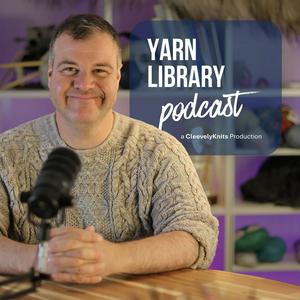
Over Yarn Library
Yarn Library is where the craft world comes to chat. Hosted by knitting influencer Adam Cleevely of CleevelyKnits
Podcast websiteLuister naar Yarn Library, Pattern Shift en vele andere podcasts van over de hele wereld met de radio.net-app
Ontvang de gratis radio.net app
- Zenders en podcasts om te bookmarken
- Streamen via Wi-Fi of Bluetooth
- Ondersteunt Carplay & Android Auto
- Veel andere app-functies
Ontvang de gratis radio.net app
- Zenders en podcasts om te bookmarken
- Streamen via Wi-Fi of Bluetooth
- Ondersteunt Carplay & Android Auto
- Veel andere app-functies

Yarn Library
Scan de code,
download de app,
luisteren.
download de app,
luisteren.
 Netherlands