PodcastsDramaReality-Based Leadership

Reality-Based Leadership

Alex Dorr
Reality-Based Leadership
Nieuwste aflevering

237 afleveringen

  • Reality-Based Leadership

    107: Stop Judging, Start Helping

    28-04-2026 | 21 Min.
    In this episode, Alex Dorr zeroes in on one of the most powerful and transformative principles in leadership: "stop judging, start helping." If there were only one mindset shift to improve culture, collaboration, and results, this would be it.
    Drawing from real-world leadership moments, Alex explains how quickly teams fall into judgment—blaming others, telling negative stories, and disengaging from solutions. But the moment leaders interrupt that pattern and redirect toward helpful action, everything changes. From workplace dynamics to personal relationships to innovation, this simple principle unlocks clarity, accountability, and forward momentum. Ultimately, this episode challenges leaders to make "stop judging, start helping" a daily, non-negotiable habit that reshapes how teams think, communicate, and perform.
    Episode Highlights:
    00:00:00 — The one principle that can transform your team: stop judging, start helping.
    00:01:00 — Why leaders default to thinking "someone else needs this" instead of applying it themselves.
    00:03:00 — The core truth: the moment you start judging is the moment you stop leading.
    00:05:00 — Brain science: why you can't judge and help at the same time.
    00:07:30 — How judgment spreads through teams and shapes culture ("where the leader goes, so goes the team").
    00:10:00 — Coaching in real time: shifting a high performer from judgment to helpful action.
    00:12:30 — Breaking silos and conflict by replacing blame with collaboration.
    00:15:30 — How removing judgment unlocks creativity and innovation in teams.
    00:18:30 — Setting boundaries in life: using "start helping" to redirect negative conversations.
    00:20:30 — The practical takeaway: make "stop judging, start helping" a team-wide habit.

  • Reality-Based Leadership

    106: How to AI-Enhance Your Drama Ditching at Work

    21-04-2026 | 16 Min.
    In this episode, Alex Dorr explores a forward-thinking leadership topic: how to use AI to enhance decision-making, reduce workplace drama, and unlock better solutions. Drawing from a recent live event, Alex walks through how modern leaders can combine Reality Based Leadership tools with AI to break through stuck thinking and accelerate progress.
    Rather than replacing human insight, AI becomes a powerful thought partner—helping teams generate ideas when energy is low, accountability is avoided, or creativity stalls. Alex highlights how tools like "thinking inside the box" and SBAR can be supercharged with AI to move teams from "why we can't" into "how we could." The episode ultimately reframes AI as a leadership advantage: not just for efficiency, but for expanding thinking, increasing accountability, and driving next right action.
    Episode Highlights:
    00:00:00 — Introducing the idea: using AI to enhance leadership and ditch workplace drama.
    00:01:30 — Why modern leaders are shifting from managing work to managing energy and thinking.
    00:03:30 — The opportunity: combining AI with Reality Based Leadership tools.
    00:06:00 — How the "thinking inside the box" framework helps teams move from excuses to solutions.
    00:08:30 — When teams get stuck: the role of ego, avoidance, and lack of willingness.
    00:10:30 — Using AI as a creative partner to generate breakthrough ideas within constraints.
    00:12:30 — The key insight: AI never runs out of ideas—even when teams do.
    00:13:45 — Identifying the real blockers: skill gaps, outdated approaches, or lack of willingness.
    00:14:45 — Enhancing the SBAR framework with AI to improve analysis and recommendations.
    00:15:45 — Why AI should support (not replace) human thinking and collaboration.
  • Reality-Based Leadership

    105: Why High Performers are Hard to Lead (and How Great Leaders Handle It)

    14-04-2026 | 17 Min.
    In this episode, Alex Dorr explores a nuanced leadership question: why can high performers be difficult to lead? Drawing from conversations sparked by viral social content and years of Reality Based Leadership work, Alex distinguishes between high performance and high accountability—two traits that often overlap, but are not always the same.
    He explains how strong performers can become challenging when they slip into righteousness, start judging others, or resist the responsibility to help elevate the team around them. Alex also unpacks how shifting workplace realities, evolving standards, and rapid change can expose whether someone is truly adaptable—or simply relying on past success. The episode ultimately challenges leaders to create cultures that support excellence without enabling drama, and to ensure their highest performers remain grounded in accountability, not just output.
    Episode Highlights with Timestamps:
    00:00:00 — Introducing the question: why are high performers often difficult to lead?
    00:02:24 — The important distinction between high performance and high accountability.
    00:04:21 — Why the same workplace cannot satisfy both high-accountability and low-accountability mindsets.
    00:05:45 — How some high performers become difficult when they step out of accountability.
    00:07:10 — The danger of "judging the judges" and when top performers start creating drama.
    00:10:00 — Why performance is increasingly becoming pass/fail in a changing, AI-shaped workplace.
    00:12:15 — How yesterday's top performer can become average if they are not ready for what's next.
    00:13:10 — High-accountability people get nervous when change is not happening.
    00:14:30 — Why great performers want leaders to hold the standard, not lower it.
    00:15:45 — Helping high performers lead with mentorship instead of judgment.
     
    Follow Alex on social media: @alexmdorr
  • Reality-Based Leadership

    104: Feeling Disengaged at Work?

    07-04-2026 | 29 Min.
    In this episode, Alex Dorr tackles a challenge that impacts nearly every workplace: disengagement. Prompted by sobering data that nearly 70% of employees feel disengaged at work, Alex unpacks why this happens—and more importantly, how to break the cycle. He reframes engagement as a personal choice, not just an organizational outcome, and challenges listeners to stop waiting for perfect conditions before leaning in.
    Through practical frameworks and real-world examples, Alex explains how stress, change, and "unpreferred reality" tempt people to mentally check out. Instead of falling into complaint or avoidance, he introduces a more empowering path: finding the "space for impact"—the narrow but powerful place between current reality and what great could look like. The episode is packed with actionable tools to help individuals and teams re-engage, take ownership, and rediscover purpose in their work. Ultimately, this conversation is both a wake-up call and a roadmap: engagement isn't about circumstances—it's about how you choose to show up within them.
    Episode Highlights with Timestamps:
    00:00:00 — Why this episode matters: addressing widespread disengagement at work.
    00:02:00 — The reality of disengagement: Gallup data and the cost of employees mentally checking out.
    00:05:30 — Engagement is a choice—even in difficult or imperfect environments.
    00:08:45 — Where disengagement begins: stress, change, and "unpreferred reality."
    00:10:30 — The trap of arguing with reality vs. taking responsibility for impact.
    00:12:00 — Finding the "space for impact" between current reality and what great looks like.
    00:14:30 — The "given that" framework: shifting from excuses to action.
    00:18:30 — Editing your story: separating facts from assumptions to unlock clarity.
    00:22:00 — Practical tools for teams: inside-the-box thinking and crowd-sourcing solutions.
    00:25:00 — Shared accountability: what leaders and teams must both own to create engagement.
  • Reality-Based Leadership

    103: How Drama Multiplies

    31-03-2026 | 25 Min.
    In this episode, Alex Dorr explores a powerful and often overlooked leadership question: does drama have an even bigger impact than we think? Building on Reality-Based Leadership's well-known 3X drama multiplier, Alex breaks down how drama doesn't just affect individual performance—it compounds across teams, cultures, and especially leadership levels.
    He introduces a simple but revealing equation for understanding the total value someone brings to a team: current performance + future potential – drama quotient. Through real-world examples, Alex highlights the danger of the "toxic high performer" and why technical skill alone isn't enough to define value. The conversation takes a deeper turn as he challenges leaders to consider how their own behavior—especially at higher levels—can amplify drama far beyond a 3X effect. Ultimately, this episode is a call to greater awareness: how leaders show up, respond, and communicate has a ripple effect that shapes the entire organization.
    For more information on the SBAR tool, check out Alex's YouTube video:https://youtu.be/wLBUIVTzVIE
    Episode Highlights with Timestamps
    00:00:00 — Introducing the question: does drama have a bigger impact than the 3X multiplier suggests?
    00:01:45 — The reality of workplace drama increasing to 2.5 hours per day per employee.
    00:03:10 — The disconnect between high performance ratings and actual team results.
    00:06:40 — The "toxic high performer" problem: high skill, high drama, low overall value.
    00:07:50 — Breaking down the value equation: performance + potential – drama quotient.
    00:10:30 — Why drama carries a 3X negative multiplier in team environments.
    00:14:50 — Comparing two high performers: skill alone vs. attitude and adaptability.
    00:18:30 — Why a "zero" (balanced performance and low drama) is the ideal sustainable target.
    00:20:40 — How leadership amplifies drama—why higher roles may carry an even greater multiplier.
    00:22:50 — Simple leadership responses ("Wow, good to know") that create space and reduce reactive drama.

Meer Drama podcasts

Over Reality-Based Leadership

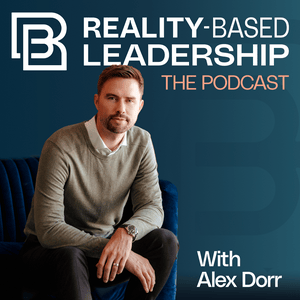
The average person spends 2.5 hours a day in drama at work. That's lost time, lost energy, and lost results. Leading beyond drama isn't optional anymore. It's the skill that separates reactive managers from transformational leaders. So how do you reclaim those hours, call your team to greatness, and restore sanity to your workplace? Welcome to Reality-Based Leadership. Hosted by Alex Dorr, CEO of Reality-Based Leadership, this podcast delivers the mindset shifts and practical tools leaders need to eliminate emotional waste, build true accountability, and turn excuses into measurable results. With years of experience working alongside leaders across industries, Alex brings real-world application, bold insight, and next practices that create ROI in the room and momentum long after. If you are ready to elevate performance and lead what's next, you are in the right place.
Podcast website

Luister naar Reality-Based Leadership, #GeenFilter en vele andere podcasts van over de hele wereld met de radio.net-app

Ontvang de gratis radio.net app

  • Zenders en podcasts om te bookmarken
  • Streamen via Wi-Fi of Bluetooth
  • Ondersteunt Carplay & Android Auto
  • Veel andere app-functies

Reality-Based Leadership: Podcasts in familie