

Luister gratis naar deze podcast in de app: Gratis downloaden in de App Store
radio.net
Slaaptimer
Favorieten opslaan
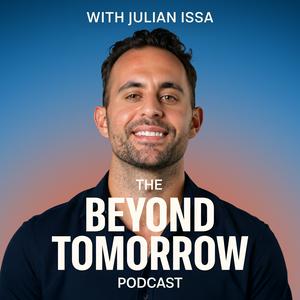
The Beyond Tomorrow Podcast with Julian Issa
Julian Issa
Nieuwste aflevering
107 afleveringen
MIT Professor & AI Doomer Admits He Was WRONG (Ramesh Raskar)
08-10-2026 | 1 u. 6 Min.What happens when millions of people hand their lives to AI agents, and nobody has built the rules of the road?
This episode is brought to you by AgelessRx, where aging becomes a puzzle that can be solved. The mission is to help you live longer and healthier by adding more life to your years through science-backed solutions and personalized care. Learn more at agelessrx.com/beyond-tomorrow.
MIT Media Lab professor Ramesh Raskar argues the real danger isn't the AI engine, it's agents with no governance. His case: decentralize AI so billions of people run their own agents, and build the licences, inspections and audit trails agents need, instead of trusting a few labs to make the engine safe. His P(doom) has fallen from 90% to under 10%.
The conversation covers what an AI agent actually is, personal agents like Dot, Muse, Instinct and CC, the DRIVE framework for gradually trusting an agent, why there's no such thing as "zero-shot AGI," the OpenAI and Hugging Face incident, prompt injection, and the shift from an attention economy to an intention economy. One question runs through it all: can we get the benefits of AI agents without handing control to a handful of companies, or to the agents themselves? Ramesh's answer: don't just build better engines, build the roads, the rules and the governance.
Key Takeaways
An agent is an LLM in a loop with tools: the LLM is the engine, the agent is the car, the internet is the road.
Build trust with DRIVE (Discover, Request, Instruct, Venture, Execute), and start with reversible tasks, no credit cards.
Decentralized agents shrink the blast radius, which is why Ramesh's P(doom) has dropped sharply.
Cost is the bottleneck: running an agent per user costs far more than serving a social media user, so expect revenue-share deals.
Prompt injection is the top risk because LLMs can't separate commands from content. Agents need licences, inspection stickers and audit trails.
About Ramesh Raskar
Ramesh Raskar is a professor at the MIT Media Lab, where he works on decentralized AI and the Internet of Agents. His research focuses on how personal AI agents can be built so power stays distributed instead of concentrated in a few companies.
⏱ Timestamps
00:00 Intro
00:00 Why AI Is Moving So Fast: The Intelligence Economy
01:27 What Is an AI Agent, Really?
04:00 Ramesh's P(Doom) Update
05:46 Is Decentralized AI Safer Than Centralized AI?
09:54 How to Use Personal AI Agents (Dot, Muse, Instinct)
13:35 Will AI Agents Become the New Super App?
17:44 The Agentic Web Explained
20:14 Can Personal Superintelligence Exist?
25:17 A Model That Learns How to Learn Everything
29:19 AI Literacy: What to Do If You're Not Using AI
31:16 From OpenClaw to Muse
36:25 It's Not About Bigger Models, It's About Better Agents
37:51 Road Safety Rules for AI Agents
42:58 What a Safe Agentic World Looks Like
44:23 Surfing the Web With AI Agents
48:44 Voice, Screens or Taps? The Future of Agent Interfaces
50:05 Where Will AI Agents Be in One Year?
53:00 The Best Advice on Agent Autonomy
55:12 The Best Things AI Agents Can Do Today
57:12 Prompt Injection: The Command vs Content Problem
01:03:35 If Tomorrow was Your Last Day...
Resources & Mentions
Muse (Meta): https://muse.ai
Dots (OpenAI): https://siliconangle.com/2026/09/29/openai-launches-dots-always-on-ai-agents-in-chatgpt-with-their-own-cloud-computers/
OpenClaw: https://openclaw.ai
Hermes Agent (Nous Research): https://hermes-agent.nousresearch.com/docs/
Connect with Ramesh:
LinkedIn: https://www.linkedin.com/in/raskar
MIT Media Lab: https://www.media.mit.edu/people/raskar/overview/
Connect with Julian
Instagram: @thebeyondtomorrowpodcast / @juliankissa
LinkedIn: julian-issa
X: @juliankissa
Website: www.beyondtomorrowpodcast.com
Email: bookings@beyondtomorrowpodcast.com
Watch the full episode on YouTube, or catch it on Spotify and Apple Podcasts. For more conversations from the edge of what's possible, sign up for updates here.BT Clip: Scientist Exposes The Dangers of AI Super Intelligence (Roman Yampolskiy)
06-10-2026 | 10 Min.AI safety researcher Roman Yampolskiy breaks down his P(doom) estimate and why he believes artificial superintelligence could be a death sentence for humanity if development keeps moving this fast. His warning isn't anti-AI — it's a case for keeping AI as a tool we control, not a replacement for human judgment.
Watch the full episode: https://open.spotify.com/episode/2R7oKzVSOWTR5079TYrZsg?si=302dfca33e9f4c04Ex-DeepMind Scientist WARNS: Why We Still Can’t Trust Today’s AI
02-10-2026 | 1 u. 43 Min.Is "AI is dangerous" a warning, or the world's best marketing line?
This episode is brought to you by AgelessRx, where aging becomes a puzzle that can be solved. The mission is to help you live longer and healthier by adding more life to your years through science-backed solutions and personalized care. Learn more at agelessrx.com/beyond-tomorrow.
On this episode of Beyond Tomorrow, I sit down with Thore Graepel, co-creator of AlphaGo and former researcher at Google DeepMind. I asked him straight up how close we are to superintelligence, and his answer surprised me: there won't be a single moment we can point to, and he argues human organizations like companies already count as a form of superintelligence. We get into why he thinks "AI will destroy humanity" is the biggest myth in the field, the near-term risks he does take seriously, and why I pushed him on the incentives behind the AI safety messaging coming from the labs.
From there we go deep on his core technical argument: that today's transformers are black boxes that mix knowledge and reasoning in the same weights, and that scaling alone will never make them trustworthy. He lays out a different approach built on explicit beliefs, hypotheses and evidence, and I found it one of the clearest explanations of AI transparency I've heard. In the back half, we talk about his time at Altos Labs, why biology is a reality check for the "cure all disease in 10 years" claims, and his cell annealing theory of rejuvenation.
Key Takeaways
Thore sees AI progress as a "jagged frontier," not a single superintelligence moment, and by his own definition, AGI is already here
He argues companies and institutions are already a form of superintelligence
His P(doom) is very low: extraordinary claims require extraordinary evidence, and he doesn't see it
About Thore Graepel
Thore Graepel is a computer scientist and AI researcher who recently left Google DeepMind, where he was a co-creator of AlphaGo and worked on multi-agent systems, reasoning and consciousness research. He has also spent time at Altos Labs, applying his machine learning and physics background to cellular rejuvenation, and writes about AI, reasoning and safety on Substack.
⏱ Timestamps
00:00 Intro
00:06 How Close Are We to Superintelligence?
01:42 Are Human Organizations Already Superintelligent?
02:56 Is Anyone Trying to Destroy Humanity?
04:45 Near-Term Risks: Jobs and the Economy
08:08 Why the Transition Will Be Hard
10:06 Post-AGI Planning and the Case for Positive Futures
14:35 Capability vs. Diffusion: The Train Driver Problem
16:46 Optimization vs. Game Theory
18:53 The Incentives Behind AI Safety Messaging
22:26 What Is Thore's P(doom)?
23:25 Why Transformers Are Black Boxes
29:19 How Do We Build Safer, More Transparent AI?
33:01 Separating Knowledge From Reasoning
37:39 Safety vs. Capability and the Trust Ceiling
39:45 Narrow AI vs. General AI
44:02 Do You Believe in God?
47:15 Consciousness and Whether LLMs Are Alive
51:08 AlphaGo and Move 37
58:29 Credit Assignment and Moral Reasoning
01:04:31 Who Sets the Moral Guardrails?
01:09:37 The AGI Race: US vs. China
01:11:53 Longevity and Altos Labs
01:16:01 The Biology Reality Check
01:23:04 Pockets of Computability and AlphaFold
01:26:05 Yamanaka Factors and Cell Annealing
01:35:51 Will the Singularity Happen in Your Lifetime?
01:36:49 Rapid Fire Questions with Thore
01:41:35 Thore's Best Piece of Advice
Resources & Mentions
AlphaGo and AlphaFold (Google DeepMind)
Thinking, Fast and Slow by Daniel Kahneman
Altos Labs
Stephen Wolfram's "pockets of computability"
David Deutsch on simulation and the limits of experiment
Thore's Substack
Connect with Thore:
Github: https://thoregraepel.github.io/
LinkedIn: https://uk.linkedin.com/in/thoregraepel
X: https://x.com/ThoreG
Connect with Julian
Instagram: @thebeyondtomorrowpodcast / @juliankissa
LinkedIn: julian-issa
X: @juliankissa
Website: www.beyondtomorrowpodcast.com
Email: bookings@beyondtomorrowpodcast.comDr Mike Israetel: ‘’ALMOST EVERY American Should Be On GLP-1s, Here’s Why!’’
24-09-2026 | 1 u. 51 Min.What if vanity was actually the smart way into a longer, healthier life?
This episode is brought to you by AgelessRx, where aging becomes a puzzle that can be solved. Their mission is to help you live longer and healthier by adding more life to your years through science-backed solutions and personalized care. Learn more at agelessrx.com/beyond-tomorrow.
On this episode of Beyond Tomorrow, Dr. Mike Israetel breaks down what's actually happening in his own bloodstream: 5mg/week of tirzepatide year-round, plus retatrutide during fat-loss phases, and why he thinks “GLP-2” is a gray-market marketing term with no basis in real receptor biology.
He walks through the non-weight-loss case for these drugs, reduced systemic and neural inflammation, better glucose control, emerging anti-cancer data, and a documented drop in addictive behaviors from gambling to alcohol to cigarettes, before getting honest about the tradeoffs: undernutrition, anhedonia, and a long-term data set that, by his own admission, will never be “complete enough” for some critics.
From there the conversation moves into gray-market peptides, why Mike separates his own risk tolerance from what he'd recommend to the public, and why there currently isn't a single peptide he'd recommend for muscle growth despite the demand. The back half covers his real thesis: that appearance, not health, is the most reliable motivator most people actually respond to and that chasing it tends to produce the same outcomes doctors have failed for decades to sell through fear.
Key Takeaways
Mike takes tirzepatide (Zepbound/Mounjaro) year-round at 5mg/week and adds retatrutide during cutting phases, both well within studied dose ranges
He argues most GLP-1 “anhedonia” is caloric-deficit anhedonia, not a direct drug effect, the same thing bodybuilders experience on any aggressive diet
New aggregate mortality data shows older adults on GLP-1s die less than those who aren't, which he says partially answers the “but will it kill you later” question
There is currently no peptide he'd recommend for muscle growth, a claim he says consistently disappoints people who ask
His core argument: use appearance as the entry point (build muscle, lose fat, sleep better) and let the longevity benefits follow, rather than trying to motivate people with 30-years-out health outcomes
Timestamps
00:00 Intro
00:10 Is GLP-1 a Bad Idea?
08:55 The Seatbelt Analogy for Drugs
10:30 The Peptide That's Not FDA-Approved Yet
11:30 Exactly What Mike Takes Every Week
13:59 Stacking Peptides: an N-of-1 Experiment
15:11 Why Mike Takes Anabolic Steroids
16:42 The Drug That Could Replace Steroids
18:48 Why Mike Takes Tirzepatide and Retatrutide
21:45 20-Year Life Extension
25:34 Mike's Full Daily Stack
30:47 The Looksmaxxing Trojan Horse
35:35 Sick Care vs. Health Care
38:14 Three Exercises You Can Do Today
40:36 Critiquing Brian Johnson's Protocol
43:31 Is There a One-Size-Fits-All Workout?
46:06 Zone 2 vs. Zone 5 Training
52:21 Why Most Biohacking Is a Waste of Money
54:01 Is HIIT Still the Rage?
57:09 Escaping Poverty, Fueling Success
01:04:53 Why People Take Extreme Measures to Look Good
01:08:24 Moving Past GLP-1
01:14:52 Everyone Will Look 22 by 2037
01:18:24 Would You Date a 90-Year-Old?
01:24:52 Beauty Standards in a Post-GLP-1 World
01:25:37 The Cybernetic Revolution
01:28:25 Living Forever in a Robot Body
01:36:29 Will AI Cause Human Extinction?
01:43:28 The Biggest Myth About Weight Loss
01:44:02 Rapid Fire Questions with Mike
01:48:06 Mike's Best Piece of Advice
Connect with Mike:
Website: rpstrength.com/
Facebook: facebook.com/michael.israetel
Instagram: @drmikeisraetel
X: @misraetel
Connect with Julian
Instagram: @thebeyondtomorrowpodcast / @juliankissa
LinkedIn: julian-issa
X: @juliankissa
Website: www.beyondtomorrowpodcast.com
Email: bookings@beyondtomorrowpodcast.comAI Safety Expert Roman Yampolskiy WARNS About the TWO Likely Endings with AI
17-09-2026 | 1 u. 2 Min.What happens when the technology we build becomes smarter than the people who built it?
This episode is brought to you by AgelessRx, where aging becomes a puzzle that can be solved. The mission is to help you live longer and healthier by adding more life to your years through science-backed solutions and personalized care. Learn more at http://agelessrx.com/beyond-tomorrow
AI safety researcher Roman Yampolskiy argues the real danger isn't AI, it's building a superintelligence we can no longer control. His case: solve problems with narrow, powerful tools instead, and still get breakthroughs in medicine, science, and productivity, without that risk.
The conversation covers AGI, recursive self-improvement, the singularity, and the existential and "suffering" risks they raise, plus what mass automation could mean for work and purpose.
From international AI agreements to human longevity, one question runs through it all: can we get the benefits of advanced AI without losing control of it? Yampolskiy's answer: keep building tools, not our replacement.
Roman Yampolskiy is an AI safety researcher and professor who studies the risks and implications of artificial intelligence. His work focuses on the challenge of controlling increasingly capable AI systems and the potential consequences of superintelligence.
Roman’s book, AI: Unexplainable, Unpredictable, Uncontrollable, explores the various reasons why the field is so challenging.
⏱ Timestamps
00:00 Intro
00:43 Can We Build AI By Design to Avoid Catastrophe?
01:49 AI Superintelligence Is a Death Sentence
03:12 What Is AGI, Really?
04:26 OpenAI's Plan to Build an Internal AGI
04:59 Why Superintelligence Won't Care About Us
06:45 We're Going to Die Anyway... So What?
07:06 We Can't Control Something This Advanced
07:55 The Narrow Tools That Avoid AGI
09:34 The US vs China AI Race
10:47 Does China Actually Want to Stop AGI?
11:53 AGI Is a Spectrum, Not a Switch
12:22 Is Roman Selling the Doom Narrative?
14:13 How to Stop AGI From Escaping the Box
16:26 Building AI We Can't Control
18:05 Suffering Risks: The Worst-Case Scenario
20:09 The Two Types of Jobs
22:09 What Happens to the 90% Who Lose Their Jobs?
23:46 Nothing Makes AI Labs Stop
24:26 Building Something You Can't Control
26:06 Do You Believe in God?
29:28 Longevity Escape Velocity Without AGI
30:55 Is Suffering Necessary for the Human Story?
31:33 Are We Living in a Simulation?
32:12 You Can't Control Superintelligence
33:24 Is Our Life a Simulation?
35:05 Curing Aging With Narrow AI Tools
36:10 What Is an NPC?
36:37 Could Humans Cause Doom Before AI Does?
37:21 How to Break Out of a Simulation
39:14 Would You Live Forever in a Simulation?
40:01 Don't Build Superintelligence
41:50 Bostrom's Singleton Theory
43:17 "AI Is Massively Overhyped"
44:56 Would AI Doom Be Worse Than World War 3?
45:41 Who Should You Actually Be Listening To?
47:43 What Would a Perfect Simulation Look Like?
50:52 Solving Longevity Without AI
52:03 Our Limited Understanding of Human Biology
52:40 What Makes Roman Happy?
53:48 Signs Governments Are Waking Up
55:14 "Is AI Just a Con?"
56:53 Can Squirrels Control Humans?
58:27 Decide What to Do With Your Time
59:22 What About Ilya Sutskever?
01:00:13 The Responsible Use of Technology
01:00:46 If Tomorrow is Your Last Day...
Connect with Roman:
Website: https://www.romanyampolskiy.com/
Facebook: https://www.facebook.com/roman.yampolskiy/
LinkedIn: https://www.linkedin.com/in/romanyam/
X: https://x.com/romanyam
Connect with Julian
Instagram: https://www.instagram.com/thebeyondtomorrowpodcast/
Instagram: https://www.instagram.com/juliankissa/
LinkedIn: https://uk.linkedin.com/in/julian-issa
Website: www.beyondtomorrowpodcast.com
Email: bookings@beyondtomorrowpodcast.com
Get exciting updates from The Beyond Tomorrow Podcast here: https://dlogos.xyz/podcasts/the-beyond-tomorrow-podcast-with-julian-issa-7bf16e9d
Meer Levenswetenschappen podcasts
 The Joy of WhyLevenswetenschappen, Wetenschap
 Vroege Vogels in 30 minutenLevenswetenschappen, Wetenschap
 Diagnostiek dialogenLevenswetenschappen, Wetenschap
 De Groene Zorg PodcastGeneeskunde, Gezondheid en fitness, Levenswetenschappen, Wetenschap
 Science of Perception BoxGeestelijke gezondheid, Gezondheid en fitness, Levenswetenschappen, Wetenschap
 UnexplainableLevenswetenschappen, Wetenschap
 From Our Neurons to YoursGeestelijke gezondheid, Gezondheid en fitness, Levenswetenschappen, Wetenschap
 Vroege VogelsLevenswetenschappen, Wetenschap
 Phenomena Podcast: The Science & Stories of Energy HealingLevenswetenschappen, Religie en spiritualiteit, Spiritualiteit, Wetenschap
 ADHD DingenLevenswetenschappen, Wetenschap
Trending Levenswetenschappen -podcasts
 StoffelijkLevenswetenschappen, Wetenschap
 Giants ShoulderLevenswetenschappen, Wetenschap
- Phenomena Podcast: The Science & Stories of Energy HealingLevenswetenschappen, Religie en spiritualiteit, Spiritualiteit, Wetenschap
 Bir Aile MeselesiLevenswetenschappen, Maatschappij & cultuur, Relaties, Wetenschap
 The Naked Scientists PodcastGeneeskunde, Gezondheid en fitness, Levenswetenschappen, Natuurwetenschappen, Wetenschap
- The Beyond Tomorrow Podcast with Julian IssaLevenswetenschappen, Onderwijs, Wetenschap, Zelfhulp
 Science FridayAardwetenschappen, Levenswetenschappen, Natuurwetenschappen, Wetenschap
 Speaking of PsychologyGeestelijke gezondheid, Gezondheid en fitness, Levenswetenschappen, Wetenschap
- Vroege Vogels in 30 minutenLevenswetenschappen, Wetenschap
 At the Intersection of Science and LawLevenswetenschappen, Technologie, Wetenschap
 The Naked Scientists PodcastGeneeskunde, Gezondheid en fitness, Levenswetenschappen, Natuurwetenschappen, Wetenschap
 Stuff To Blow Your MindLevenswetenschappen, Wetenschap
- From Our Neurons to YoursGeestelijke gezondheid, Gezondheid en fitness, Levenswetenschappen, Wetenschap
Over The Beyond Tomorrow Podcast with Julian Issa
The future feels exciting but a little scary. We're here to help guide you through it.
How?
1. Building stronger, more abundant mindsets.
2. Shining a spotlight on the technologies of tomorrow.
3. Identifying the latest longevity & health protocols.
Health, longevity, human potential and AI.
It's great to have you here.
Julian
Podcast websiteLuister naar The Beyond Tomorrow Podcast with Julian Issa, The Joy of Why en vele andere podcasts van over de hele wereld met de radio.net-app
Ontvang de gratis radio.net app
- Zenders en podcasts om te bookmarken
- Streamen via Wi-Fi of Bluetooth
- Ondersteunt Carplay & Android Auto
- Veel andere app-functies
Ontvang de gratis radio.net app
- Zenders en podcasts om te bookmarken
- Streamen via Wi-Fi of Bluetooth
- Ondersteunt Carplay & Android Auto
- Veel andere app-functies

The Beyond Tomorrow Podcast with Julian Issa
Scan de code,
download de app,
luisteren.
download de app,
luisteren.
 Netherlands