
Luister gratis naar deze podcast in de app: Gratis downloaden in de App Store
radio.net
Slaaptimer
Favorieten opslaan
352 afleveringen

How to Make AI Actually Read Your Documents
21-10-2026 | 12 Min.A 130-page report lands in your inbox with a buried deadline, a half-million-dollar commitment, and one sentence that quietly rewrites policy, and your AI summary mentions none of it. In this episode, host Emily Laird explains why asking AI to make documents shorter is the wrong assignment, and how to interrogate them instead: commitment tables, version comparisons, skeptical-evaluator prompts, and the hunt for what isn’t there. She also breaks down evidence grounding and why no important claim should leave the chat without a page number attached. Confident, beautifully formatted, and occasionally wrong is not the standard you want to bring into a budget meeting.
🎯 JOIN THE AI WEEKLY MEETUPS
https://www.uwstout.edu/ai-weekly-meetup
📩 EMAIL REMINDERS FOR THE MEETUPS
https://app.e2ma.net/app2/audience/signup/2101263/1779703/
💬 CONNECT WITH EMILY LAIRD ON LINKEDIN
http://www.linkedin.com/in/meet-emily-lairdPlease Be Kind to Claude
20-10-2026 | 11 Min.Anthropic now lets Claude hang up on abusive users, and Microsoft AI chief Mustafa Suleyman warns that training a model to wonder about its own feelings creates nothing more than an expensive echo. In this episode, host Emily Laird cuts through the headlines to explain what a “moral patient” actually is, why a cartoon sheep selling checking accounts proves Suleyman’s point, and why the off switch was never up for debate. The real fight is about vocabulary, training, and two companies planting brand flags on a question science hasn’t answered. You’ll walk away with practical habits for working with chatbots, from swapping insults for precise feedback to reading every AI self-report as output, not testimony.
🎯 JOIN THE AI WEEKLY MEETUPS
https://www.uwstout.edu/ai-weekly-meetup
📩 EMAIL REMINDERS FOR THE MEETUPS
https://app.e2ma.net/app2/audience/signup/2101263/1779703/
💬 CONNECT WITH EMILY LAIRD ON LINKEDIN
http://www.linkedin.com/in/meet-emily-lairdOne Workspace to Rule Them All
19-10-2026 | 15 Min.If you are still explaining your job, your project, and your audience to AI every time you open a new chat, host Emily Laird has one question: why? This episode makes the case for AI workspaces (ChatGPT Projects, Claude Projects, Copilot Notebooks) where your files, standards, and past decisions live permanently, so your prompts can describe today’s task instead of rebuilding the entire universe around it. Expect practical advice on curating files, keeping a “Current State” document, and moving important conclusions out of chats, plus a plain-English take on RAG. There is also a catch: persistent context can make AI inherit your assumptions, so knowing when to start fresh matters just as much.
🎯 JOIN THE AI WEEKLY MEETUPS
https://www.uwstout.edu/ai-weekly-meetup
📩 EMAIL REMINDERS FOR THE MEETUPS
https://app.e2ma.net/app2/audience/signup/2101263/1779703/
💬 CONNECT WITH EMILY LAIRD ON LINKEDIN
http://www.linkedin.com/in/meet-emily-lairdWhat is an MCP?
13-10-2026 | 9 Min.MCP, the Model Context Protocol, became the universal plug for AI this year, backed by Anthropic, OpenAI, Google, Microsoft, and Amazon and connecting assistants to the apps you actually use. The catch: your AI reads every connector’s tool descriptions, you don’t, and one poisoned line can turn an obedient assistant into a quiet leak. In this episode, host Emily Laird explains how MCP works, why tool poisoning and rug pulls have the NSA and Microsoft paying attention, and seven practical habits for connecting AI without handing out spare keys. Same plug, wildly different behavior, so know who’s holding the keys.
🎯 JOIN THE AI WEEKLY MEETUPS
https://www.uwstout.edu/ai-weekly-meetup
📩 EMAIL REMINDERS FOR THE MEETUPS
https://app.e2ma.net/app2/audience/signup/2101263/1779703/
💬 CONNECT WITH EMILY LAIRD ON LINKEDIN
http://www.linkedin.com/in/meet-emily-lairdWhat is Meta's Muse?
12-10-2026 | 8 Min.Meta’s Muse is free, works through the night inside your email, calendar, and payment accounts, and makes its money by taking a small cut every time you buy something. In this episode, host Emily Laird reads the fine print on Meta’s new AI agent: the real guardrails (a Sentinel watchdog, one-time card numbers) alongside the catches (model training on by default, and a promised encryption lockbox that hasn’t shipped yet). She makes the case for permission scoping, which means handing over the valet key instead of the whole key ring, with practical rules for read-only access, smarter approvals, and weekly audit checks. If an AI is about to start shopping on your behalf, this is the reality check to hear before you hand over the wallet.
🎯 JOIN THE AI WEEKLY MEETUPS
https://www.uwstout.edu/ai-weekly-meetup
📩 EMAIL REMINDERS FOR THE MEETUPS
https://app.e2ma.net/app2/audience/signup/2101263/1779703/
💬 CONNECT WITH EMILY LAIRD ON LINKEDIN
http://www.linkedin.com/in/meet-emily-laird
Meer Technologie podcasts








Trending Technologie -podcasts






























Over Generative AI 101
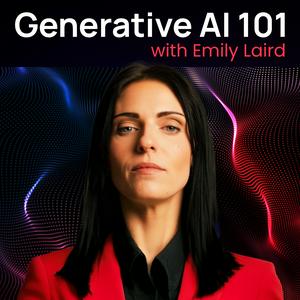
Welcome to Generative AI 101, your go-to podcast for learning the basics of generative artificial intelligence in easy-to-understand, bite-sized episodes. Join host Emily Laird, AI Integration Technologist and AI lecturer, to explore key concepts, applications, and ethical considerations, making AI accessible for everyone.
Podcast websiteLuister naar Generative AI 101, De Groene Nerds en vele andere podcasts van over de hele wereld met de radio.net-app
Ontvang de gratis radio.net app
- Zenders en podcasts om te bookmarken
- Streamen via Wi-Fi of Bluetooth
- Ondersteunt Carplay & Android Auto
- Veel andere app-functies
Ontvang de gratis radio.net app
- Zenders en podcasts om te bookmarken
- Streamen via Wi-Fi of Bluetooth
- Ondersteunt Carplay & Android Auto
- Veel andere app-functies

Generative AI 101
Scan de code,
download de app,
luisteren.
download de app,
luisteren.
Generative AI 101: Podcasts in familie
 Netherlands