
Luister gratis naar deze podcast in de app: Gratis downloaden in de App Store
radio.net
Slaaptimer
Favorieten opslaan
74 afleveringen
Electrochemical Impedance Spectroscopy (EIS) for A-BMS
17-11-2026 | 10 Min.In this episode of the Podcast4Engineers, host Kelsey sits down with Christian Walther to explore electrochemical impedance spectroscopy (EIS), one of the most promising trends in automotive battery management systems. Discover how EIS lets a BMS measure internal cell temperature and read state of charge and state of health directly from the cell, rather than relying on models and estimates. Christian explains why this well-known research method is only now moving into cars, and how it could act as an early thermal runaway indicator to improve battery safety. You'll also learn why accurate state of health data matters for a used car's resale value, and how it could support the upcoming EU battery passport. Finally, he explains what engineers should look for in BMS ICs, such as fast communication and synchronized measurement, when designing an EIS-ready system.GaN, Decoded: What does “fast switching” really mean?
09-11-2026 | 17 Min.What does “fast switching” really mean when we talk about GaN? In the first episode of GaN Decoded, host Peter Balint sits down with Infineon lead principal engineer Edward Jones to explore the difference between switching frequency and switching speed, and why GaN can deliver benefits ranging from higher power density and efficiency to lower switching losses. From AI data centers and humanoid robots to appliances and bidirectional switches, they examine where GaN’s unique characteristics matter and what engineers need to consider when designing fast-switching systems.Trends in Battery Management Systems (BMS)
30-10-2026 | 22 Min.In this episode of the Podcast for Engineers, host Kelsey speaks with Infineon system architect Wolfgang Novak about the critical role of Battery Management Systems (BMS) in electric vehicles. They explore how advanced BMS technologies improve battery safety, performance, and lifetime by accurately monitoring voltage, temperature, and state of charge. The discussion highlights future innovations such as electrochemical impedance spectroscopy, AI-powered battery analytics, and smarter system architectures. Wolfgang also shares insights into a groundbreaking silicon carbide proof-of-concept capable of disconnecting 800V and 650A in just two microseconds, dramatically improving electrical safety. Tune in to discover how next-generation battery management is shaping the future of electric mobility.Powering tomorrow: The global infrastructure behind AI
06-10-2026 | 20 Min.AI may run on data, but its future depends just as much on power. In the eighth and final episode of the "We Power AI" series on Podcast4Engineers, host Kelsey Markl welcomes Andreas Weisl, CSO of the Industrial and Infrastructure Sales segment at Infineon, to look beyond the data center and explore the global race to build the power infrastructure needed for the AI era. Drawing on his experience across major transformations in lighting, automotive, and industrial markets, Andreas shares what past technology shifts can teach us about the transition ahead and why successful transformation requires much more than breakthrough technology alone. Together, they examine how different regions are responding to rapidly growing electricity demand, why aging and constrained grids are becoming a critical challenge, and how technologies such as silicon carbide, GaN, solid-state transformers, energy storage, and intelligent power systems can help create more efficient and reliable infrastructure. The discussion also looks beyond cloud AI toward the next frontier: physical AI, robotics, autonomous systems, and intelligent machines at the edge. As the "We Power AI" series comes to a close, this episode connects the dots between AI, electrification, semiconductors, and the energy systems that will power the next wave of technological transformation.Liquid cooling of AI data centers
15-09-2026 | 15 Min.As AI data centers push server power to unprecedented levels - reaching 600 kilowatts by 2027 and potentially megawatt-scale by the 2030s - the challenge of keeping these systems cool has never been more critical. In this episode of "We Power AI" on Podcast4Engineers, host Kelsey Markl sits down with Muzaffer Albayrak, Application Marketing Manager at Infineon, to explore the evolving world of data center cooling technologies. Together, they break down the shift from traditional air cooling to advanced liquid cooling methods, including direct-to-chip cooling, rear door heat exchangers, and immersion cooling, while examining the crucial role of Power Usage Efficiency (PUE) in measuring data center performance. The conversation dives into the semiconductor solutions - from silicon to wide-bandgap materials like silicon carbide and GaN - that power the fans, pumps, and inverters keeping these massive systems from overheating. Whether you're curious about cooling distribution units, centralized cooling architectures, or the future of AI infrastructure, this episode offers essential insights into one of the most pressing engineering challenges in the AI revolution.
Meer Technologie podcasts







Trending Technologie -podcasts












Over Podcast4Engineers
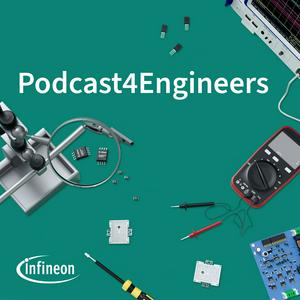
We’re bringing you the latest from the world of semiconductors – straight to your ears! From quick takes on trending applications to deep dives on product innovations, our experts give you their take on the tech behind the tech.
Join our hosts Peter Balint and Kelsey Markl, as they seek out some of Infineon’s greatest technical minds to discuss the biggest challenges and opportunities engineers face today and what the team at Infineon is doing to address them. So listen to our podcast at home, in the office, or on the go – we’re transmitting our know-how directly to you, wherever you are.
Podcast websiteLuister naar Podcast4Engineers, Cryptocast | BNR en vele andere podcasts van over de hele wereld met de radio.net-app
Ontvang de gratis radio.net app
- Zenders en podcasts om te bookmarken
- Streamen via Wi-Fi of Bluetooth
- Ondersteunt Carplay & Android Auto
- Veel andere app-functies

Podcast4Engineers: Podcasts in familie
 Netherlands

