

Luister gratis naar deze podcast in de app: Gratis downloaden in de App Store
radio.net
Slaaptimer
Favorieten opslaan
93 afleveringen
The Future of the Beach
10-09-2026 | 34 Min.We love our beaches. We build homes beside them, vacation on them, and spend billions of dollars trying to keep them from disappearing. But beaches are supposed to move—and as sea levels rise, keeping them in place is becoming more expensive, more difficult, and possibly impossible.
So what happens when the sand, the money, and the time start running out? Coastal geologist Rob Young says we’re going to have to make some hard choices about what we protect, what we let go, and who pays for the risk.
For more information, studies, and data about beach nourishment, buyouts, and adaptation at the coast, check out the Program for the Study of the Developed Shoreline's website.
Additional resources:
Rebuild by Design
NOAA's Sea Level Rise Viewer
The Water Institute's Community Resilience Center
This episode was hosted by Executive Producer Carlyle Calhoun. Our theme music is by Jon Batiste, and our sound designer is Emily Jankowski. Sea Change is a WWNO and WRKF production. We are part of the NPR Podcast Network and distributed by PRX. Sea Change is made possible with major support from the Gulf Research Program of the National Academy of Sciences, Engineering, and Medicine. WWNO’s Coastal Desk is supported by the Walton Family Foundation, the Meraux Foundation, and the Greater New Orleans Foundation.From Puffins to Pelicans: How to Save a Seabird
27-08-2026 | 44 Min.What does it take to bring a seabird back from the brink—and can we keep it there? We travel from a rocky island of Maine to a tiny restored island in coastal Louisiana to learn the astonishing comeback stories of two beloved birds, puffins and pelicans. This is a hopeful story about how innovative ideas can save wildlife — and asks whether that's enough in a rapidly changing world.
Want to know more about birds on the Gulf Coast? Check out the Avian Monitoring Dashboard where you'll find interactive maps, aerial surveys, photos, and an incredible amount of fascinating bird data.
CREDITS
This episode was reported by Katelyn Harrop and Michael McEwan and hosted by Executive Producer Carlyle Calhoun. Eve Abrams edited the pelicans story. The puffins story was edited by Carlyle Calhoun. The episode was fact-checked by Philip Kiefer with help from Shruti Gautam. Sound design by Rebecca Nolan and our theme music is by Jon Batiste.
Sea Change is made possible with major support from the Gulf Research Program of the National Academy of Sciences, Engineering, and Medicine. WWNO’s Coastal Desk is supported by the Walton Family Foundation, the Meraux Foundation, and the Greater New Orleans Foundation.The Fight Over Culatra Island: When Nature Wins, Must People Lose?
12-08-2026 | 41 Min.Throughout the Western history of conservation, protecting nature has often meant removing people. It's what happened during the creation of many of America's national parks. But what if protecting nature didn't have to mean displacing the people who call it home? That's the question that brings us to Culatra, a small fishing island off Portugal's southern coast, and one of the country's seven natural wonders.
For decades, the Portuguese government saw only one way to save the fragile lagoon surrounding Culatra: kick out the residents. This episode follows one woman's decades-long fight for her island — and the unlikely alliance she built along the way with the very scientists once sent to evict her.
CREDITS
This episode was reported and produced by Geert Vlieger. Sound design also by Geert. Johanna Zorn edited the episode with help from Executive Producer Carlyle Calhoun. Fado was performed on acoustic guitar by Ricardo Martins and Cláudio Sousa. All other music in the episode is composed and produced by Geert. Sea Change’s theme music is by Jon Batiste. Archival tape from Cristiano Guerreiro.
Production of this episode was made possible with support from the Walden Collective and Sciaena, and funding from the European Union’s Big Green Project. One brief update: Valentina Munoz is now in Lisbon and is no longer working for the NGO, but hopes to continue working on community-based ocean protection programs.
Sea Change is a WWNO and WRKF production. We are part of the NPR Podcast Network and distributed by PRX. And to help others find our podcast, please share this episode with a friend!
Sea Change is made possible with major support from the Gulf Research Program of the National Academy of Sciences, Engineering, and Medicine. WWNO’s Coastal Desk is supported by the Walton Family Foundation, the Meraux Foundation, and the Greater New Orleans Foundation.Surfing in a Plastic Sea
30-07-2026 | 35 Min.Neil McQueen learned to surf as a Texas teenager, and it changed his life – eventually pulling him away from a career as a plastics engineer and into the fight to save the very waters that shaped him. Thanks to the way ocean currents loop through the Gulf, the Texas coast collects roughly 10 times more plastic debris than any other Gulf state, much of it spilling from the massive petrochemical complex that lines its shores.
In this episode of Sea Change, reporter Avery Thompson follows Neil from the surf off Mustang Island to the halls of the Texas Capitol to witness a personal reckoning with the plastics economy that helped build modern Texas—and one man’s determination to leave the ocean better than he found it.
To learn more about the citizen-led science project tracking pre-production plastics, called nurdles, check out the Nurdle Patrol. And for more about the Surfrider Foundation's work on the Texas coast, click here.
CREDITS
This episode was reported by Texas-based reporter Avery Thompson. It was edited by Carlyle Calhoun and Eve Abrams, with additional help from Johanna Zorn, Eva Tesfaye, and Michael McEwan. Carlyle Calhoun is the executive producer. Our theme music is by Jon Batiste, and sound design by Dennis Funk with help from Avery Thompson.
Sea Change is a WWNO and WRKF production. We are part of the NPR Podcast Network and distributed by PRX. Sea Change is made possible with major support from the Gulf Research Program of the National Academy of Sciences, Engineering, and Medicine. WWNO’s Coastal Desk is supported by the Walton Family Foundation, the Meraux Foundation, and the Greater New Orleans Foundation.From Foe to Friend: The Dutch Rethink Their War Against the Sea
15-07-2026 | 26 Min.In the Netherlands, water has always been both a threat and a triumph. A quarter of the country lies below sea level, and for centuries the Dutch have engineered their way to safety. It’s a place not unlike New Orleans: a delta shaped by risk, resilience, and the belief that with enough ingenuity, water can be controlled. But as sea levels rise, that centuries-old confidence is beginning to crack.
In this episode of Sea Change, reporter Jonathan Groubert takes us to the Netherlands to explore a relationship in turmoil. From floating farms to visions of entire cities on water, the Dutch are beginning to rethink everything they thought they knew. The question is no longer how to win the war against water—but whether it’s time to learn how to live with it.
Meer Natuur podcasts
 Red de LenteDocumentaire, Maatschappij & cultuur, Natuur, Technologie, Wetenschap
 VogelpassieNatuur, Onderwijs, Wetenschap
 Bomen over bosDocumentaire, Maatschappij & cultuur, Natuur, Vrije tijd, Wetenschap
 The Nature Of with Willow DefebaughFilosofie, Maatschappij & cultuur, Natuur, Religie en spiritualiteit, Spiritualiteit, Wetenschap
 Van Delta tot DiepzeeNatuur, Onderwijs, Wetenschap
 ZaailingenNatuur, Wetenschap
 Nocturnal WorldsGezondheid en fitness, Maatschappij & cultuur, Natuur, Wetenschap
 Boven WaterDocumentaire, Maatschappij & cultuur, Natuur, Wetenschap
 DwaalgastenNatuur, Onderwijs, Wetenschap
Trending Natuur -podcasts
- DwaalgastenNatuur, Onderwijs, Wetenschap
 The Wild with Chris MorganNatuur, Wetenschap
 Peter und der WaldNatuur, Wetenschap
 Radio RoodborstNatuur, Wetenschap
 Just the Zoo of UsDieren, Kind en gezin, Natuur, Wetenschap
 The Birding Life Podcast NetworkHobby's, Natuur, Sociale wetenschappen, Vrije tijd, Wetenschap
 The PlodcastMaatschappij & cultuur, Natuur, Steden en reizen, Wetenschap
 Stuifmail Podcast - Alles over de natuurHuis en tuin, Natuur, Onderwijs, Stap voor stap, Vrije tijd, Wetenschap
 Scotland OutdoorsNatuur, Wetenschap
- The Nature Of with Willow DefebaughFilosofie, Maatschappij & cultuur, Natuur, Religie en spiritualiteit, Spiritualiteit, Wetenschap
Over Sea Change
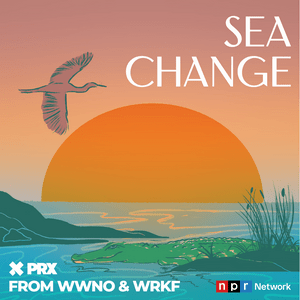
Living on the coast means living on the front lines of a rapidly changing planet. And as climate change transforms our coasts, that will transform our world.Every two weeks, we bring you stories that illuminate, inspire, and sometimes enrage, as we dive deep into the environmental issues facing coastal communities on the Gulf Coast and beyond. We have a lot to save, and we have a lot of solutions. Join us as we investigate and celebrate life on a changing coast. It’s time to talk about a Sea Change.Based in New Orleans, Sea Change is a production of WWNO New Orleans Public Radio and WRKF Baton Rouge Public Radio. Sea Change is a part of the NPR Podcast Network and is distributed by PRX. Hosted by Carlyle Calhoun. Our theme song is by Jon Batiste.Sea Change is made possible with major support provided by The Gulf Research Program of the National Academies of Sciences, Engineering, and Medicine and The Water Collaborative. The Coastal Desk is supported by the Walton Family Foundation, the Greater New Orleans Foundation, and the Meraux Foundation.
Podcast websiteLuister naar Sea Change, Bird Curious en vele andere podcasts van over de hele wereld met de radio.net-app
Ontvang de gratis radio.net app
- Zenders en podcasts om te bookmarken
- Streamen via Wi-Fi of Bluetooth
- Ondersteunt Carplay & Android Auto
- Veel andere app-functies
Ontvang de gratis radio.net app
- Zenders en podcasts om te bookmarken
- Streamen via Wi-Fi of Bluetooth
- Ondersteunt Carplay & Android Auto
- Veel andere app-functies

Sea Change
Scan de code,
download de app,
luisteren.
download de app,
luisteren.
 Netherlands