

Luister gratis naar deze podcast in de app: Gratis downloaden in de App Store
radio.net
Slaaptimer
Favorieten opslaan
The Road to Accountable AI
Kevin Werbach
Nieuwste aflevering
75 afleveringen
Sharon Goldman (Ground Level AI): AI as It Meets the Real World
08-10-2026 | 33 Min.Kevin Werbach speaks with AI journalist Sharon Goldman about her new venture, Ground Level AI. Goldman describes taking on the AI beat at VentureBeat in 2022, months before ChatGPT launched, and then learning to translate technical developments for Fortune's broad business audience. She explains why she left to launch her own newsletter and podcast, focused on infrastructure, security, governance, policy, and the communities absorbing AI's effects.
Goldman shares her reporting from data center sites, and weighs how much of the data center backlash reflects local impacts versus broader anxieties about AI. The conversation turns to cybersecurity, where the speed and scale of AI-enabled attacks may outpace defenders. Goldman argues that the AI safety and cybersecurity communities, long divided by culture, must now work together. She closes on what she thinks is underappreciated: how quickly things are changing.
Sharon Goldman is the founder of Ground Level AI. She spent four years covering the AI boom, most recently at Fortune and before that at VentureBeat, and has more than 15 years of experience covering technology and business for publications including Business Insider, Forbes, and CIO. She launched Ground Level AI in June 2026 as a newsletter and podcast on Substack.
Transcript
Ground Level AI
Who gets a seat at the table to decide if frontier AI is safe?
AI safety and cybersecurity have long been two different worlds. In the age of AI agents, they're collidingRobert Levitan (Ethical Tech Project): Unlimited Intelligence, But Where's the Wisdom?
01-10-2026 | 36 Min.Kevin Werbach speaks with Robert Levitan, Chair of the Ethical Tech Project, about what the early internet can teach companies deploying AI today. Levitan, who helped build iVillage and Flooz.com in the dot-com era, argues that the central lesson of those years is that new technologies always carry unintended consequences. Moving fast and breaking things is untenable, he says, now that AI sits on top of the internet and mobile. Levitan explains his essay comparing a coming AI disaster to the 1911 Triangle Shirtwaist Factory fire, which spurred workplace safety laws and helped shape the New Deal. He expects a comparable AI catastrophe to trigger regulation, and urges executives not to wait for it. Trust is a competitive advantage, he argues, and litigation will arrive much faster than it did for the internet. The conversation closes with why Levitan remains an optimist despite the risks, pointing to healthcare's ethical framework and guardrails as a model for other industries.
Disclosure: Kevin Werbach is an advisor to the Ethical Tech Project.
Over thirty years, Robert Levitan has founded, scaled, and advised companies including iVillage, Flooz.com, and Pando Networks, and his recent work focuses on the societal impacts of AI. He studied history and public policy in college and describes himself as a serial entrepreneur whose ventures have ranged from a high-profile IPO to a high-profile bankruptcy to a private sale to Microsoft.
Transcript
Our AI Triangle Shirtwaist Moment Is Coming. Don't Be the Factory Owner (LinkedIn)
Pulse 2.0 interview with LevitanHarish Peri (Okta): When the Thing Accessing Your Systems Has a Brain
25-06-2026 | 33 Min.In the final episode of our series on governing AI agents, Kevin Werbach speaks with Harish Peri, SVP and General Manager for AI Security at Okta. Peri frames agent governance as the natural next chapter of what Okta has done for two decades: standing in the middle of people accessing technology. The twist is that the new "software" is a non-deterministic agent with a brain, which imposes a much higher security bar. He argues that agents live at the application layer, where the real question is one of authorization: is this agent allowed to take this action or access this data, at this moment, on behalf of this user, given all available signals? Much of the conversation explores why a neutral, independent control plane separate from the frontier models and agent runtimes matters from a cybersecurity standpoint, spreading risk across multiple layers rather than concentrating it in one place.
Peri notes that while awareness of rogue AI is universal, roughly 20% of agents carry about 80% of the risk. He distinguishes security threats like prompt injection and poisoned skill files from "intent mismatch," where an under-specified instruction such as "clean this up" gets read as "delete," and explains how coarse-grained limits, fine-grained context-based authorization, and selectively applied human-in-the-loop checks each play a role in agent governance.
Harish Peri is the SVP and General Manager for AI Security at Okta, where he leads product, go-to-market, and commercial strategy for securing agentic AI. He has more than 20 years of experience across engineering, product management, marketing, and general management, spanning financial services, technology, and human capital management, with prior roles at Salesforce, ADP, and Proxyclick. He holds an MBA from the Haas School of Business at UC Berkeley.
Transcript
The Future of AI Security: The Right Architecture for Agents
Secure Your Business Against AI AgentsLogan Kelly (Waxell): The Accidental Agent Governance Company
18-06-2026 | 33 Min.Logan Kelly never set out to build an AI governance solution. Waxell spun out of CallSine, an AI-native sales engagement platform, when the team realized that agents that could act on their own produced a cascade of problems: burning through tokens, accessing databases, creating data-quality issues, and generally doing things no one had explicitly approved. Unable to find existing tooling that addressed the problems effectively, the team built a control plane for agents, which became the foundation of Waxell.
In this episode in our series on governing AI agents, CEO Logan Kelly emphasizes that governance should be legible to finance, legal, and compliance teams, not just developers. As he explains, agent governance is less about exotic AI risks than about visibility and control over things companies already care about, such as cost, data access, and who's allowed to do what. Kelly makes the case that the worst outcome isn't an agent misbehaving but companies losing trust in agents altogether and missing their value—arguing that every major technology, from cloud computing onward, arrived with new risks that good governance ultimately made manageable. Looking ahead, he bets that flexible, general-purpose governance will win out over locked-in "walled garden" platforms, as the pace of change in AI keeps accelerating..
Logan Kelly is the Co-Founder and CEO of Waxell, an AI governance and agent observability company that provides a control plane for operating autonomous AI agents in production. The company entered public beta in early 2026.
TranscriptNadav Cornberg (Eve Security): Interrogating Agents Before They Act
11-06-2026 | 32 Min.Kevin Werbach speaks with Nadav Cornberg, co-founder and CEO of Eve Security, about securing agentic AI where it counts: at the moment an agent actually does something. He recounts how customers upended his own assumptions that AI agent security should focus on visibility and after-the-fact detection. Buyers insisted on runtime enforcement first, reasoning that learning a production database was deleted after the fact helps no one. With Eve's "interrogation" approach, when an agent attempts an anomalous, high-risk action, Eve's agent-in-the-loop pauses and questions it about its intent, before approving, blocking, or escalating to a human.
Cornberg describes building a deterministic enforcement layer on top of inherently non-deterministic models, with the system minting explicit rules from observed behavior so that the large majority of everyday requests resolve deterministically. Ultimately, the consequenes are the same whether an unintended action originates in a prompt injection or a simple hallucination. On the perennial human-in-the-loop question, Cornberg argues that escalating everything would drown security teams as the agentic workforce scales, so the platform automatically handles lower-risk cases with justification and reserves human review for the genuinely critical. He closes predicting that "agentic security" will fragment into distinct segments much as endpoint, network, and cloud security once did, and that intent is fast becoming the field's organizing idea.
Nadav Cornberg is the co-founder and CEO of Eve Security, an Austin-based agentic AI observability and policy-enforcement company whose platform governs how AI agents interact with an organization's most critical systems. He brings roughly two decades in product development and engineering, including an early decade in cybersecurity at RSA and Check Point and later work in physical access security across gaming and hospitality before returning to security for the agentic era.
Transcript
Founders' blog: Why We Started Eve Security
Meer Technologie podcasts






Trending Technologie -podcasts

















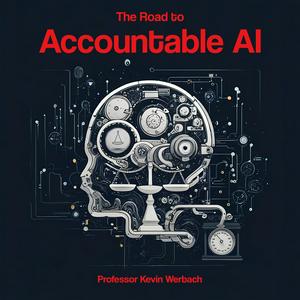
Over The Road to Accountable AI
Artificial intelligence is changing business, and the world. How can you navigate through the hype to understand AI's true potential, and the ways it can be implemented effectively, responsibly, and safely? Wharton Professor and Chair of Legal Studies and Business Ethics Kevin Werbach has analyzed emerging technologies for thirty years, and created one of the first business school course on legal and ethical considerations of AI in 2016. He interviews the experts and executives building accountable AI systems in the real world, today.
Podcast websiteLuister naar The Road to Accountable AI, De Technoloog | BNR en vele andere podcasts van over de hele wereld met de radio.net-app
Ontvang de gratis radio.net app
- Zenders en podcasts om te bookmarken
- Streamen via Wi-Fi of Bluetooth
- Ondersteunt Carplay & Android Auto
- Veel andere app-functies
Ontvang de gratis radio.net app
- Zenders en podcasts om te bookmarken
- Streamen via Wi-Fi of Bluetooth
- Ondersteunt Carplay & Android Auto
- Veel andere app-functies

The Road to Accountable AI
Scan de code,
download de app,
luisteren.
download de app,
luisteren.
 Netherlands
