
Luister gratis naar deze podcast in de app: Gratis downloaden in de App Store
radio.net
Slaaptimer
Favorieten opslaan
180 afleveringen
Why fighting corruption is more complicated than we think | Michael Johnston
21-10-2026 | 52 Min.Is corruption the world's favorite scapegoat for failed development? And why are wealthy democracies so eager to lecture poorer countries about good governance while struggling with corruption at home?
In this episode of In Pursuit of Development, Dan Banik speaks with Michael Johnston, Professor Emeritus of Political Science at Colgate University and one of the world's leading scholars of corruption.
Drawing on decades of research, Johnston challenges conventional thinking about corruption, arguing that it goes far beyond bribery and illegal transactions. The conversation explores how political influence, elite networks, and the abuse of power shape societies, including some of the world's most established democracies.
They discuss Johnston's influential four syndromes of corruption, the limitations of global corruption rankings, the relationship between corruption and economic development, and the dangers of politicians weaponizing anti-corruption rhetoric. The discussion also examines the shortcomings of international efforts to promote good governance.
Host:
Professor Dan Banik,
https://www.linkedin.com/in/dan-banik/
Subscribe:
Apple Spotify YouTube
https://globaldevpod.substack.com/Voice without authority: The Global South after Aid | Dan Banik
14-10-2026 | 18 Min.The Global South is more visible, more vocal, and more organized than at any point in recent decades. But has that translated into real power? In this season-opening episode of In Pursuit of Development, Dan Banik challenges the familiar claim that the Global South is simply “rising.” His argument is more demanding. Gaining voice in global governance is not the same as gaining authority over the rules, institutions, and decisions that shape the international order.
Against the backdrop of collapsing foreign aid, an expanding BRICS, greater representation of developing countries in the G20, negotiations over a new UN tax convention, debates over IMF reform, and the selection of the next UN Secretary-General, the episode asks where power is actually shifting. And where it is not. The emerging pattern is striking. The Global South has made significant gains in institutions based on sovereign equality, but much less progress where weighted voting, veto power, and great-power privilege still dominate.
The episode also questions whether “the Global South” can meaningfully be treated as a single bloc. Instead, Dan argues that we are increasingly seeing flexible issue-based coalitions, in which countries cooperate on taxation, climate finance, debt, or institutional reform while competing fiercely on other questions. And as the traditional aid era recedes, the politics of development may increasingly shift toward domestic taxation, accountability, South–South cooperation, and new forms of financial power.
The central question for Season 7 is therefore not whether the Global South is rising. It is whether contestation can become renegotiation. And whether greater voice can ultimately be converted into the authority to write the rules.
Host:
Professor Dan Banik,
https://www.linkedin.com/in/dan-banik/
Subscribe:
Apple Spotify YouTube
https://globaldevpod.substack.com/Why hope is what we need | Dan Banik
17-06-2026 | 31 Min.What does it mean to defend hope in an age of crisis, anxiety, and political exhaustion? In this Season 6 finale of In Pursuit of Development, Dan Banik reflects on why hope is not the same as optimism, and why evidence-based hope may be one of the most important political resources of our time.
Drawing on debates about global poverty, democracy, climate anxiety, development practice, and collective action, this solo reflection challenges the seductive power of despair. The episode argues that doom is not only emotionally draining, but politically disabling, because it can convince people that action no longer matters. Against both naïve optimism and fatalistic pessimism, Dan makes the case for a disciplined form of hope grounded in evidence, historical progress, institutional realism, and the everyday work of building better futures.
The episode also explores why hope must be treated critically. Hope can inspire movements, sustain democratic struggle, and help communities imagine alternatives. But it can also be misused by those in power to postpone justice, ration expectations, or ask vulnerable people to endure indefinitely. The task, then, is not to abandon hope, but to make it accountable to evidence, delivery, and real improvements in people’s lives.
From falling extreme poverty and declining child mortality to the limits of today’s development models, from Paulo Freire and Václav Havel to Arjun Appadurai, Rebecca Solnit, Amartya Sen, Hans Rosling, Hannah Ritchie, and Charles Kenny, this episode asks what kind of hope can survive contact with reality. It closes Season 6 with a plea to younger listeners in particular: resist the politics of despair, look carefully at what is working, and remember that the future remains open.
Host:
Professor Dan Banik,
https://www.linkedin.com/in/dan-banik/
Subscribe:
Apple Spotify YouTube
https://globaldevpod.substack.com/How civil society adapts when aid shrinks | Tikhala Itaye
03-06-2026 | 48 Min.As traditional aid budgets shrink and donor priorities shift, civil society organizations across Malawi are being forced to rethink how they work, survive, and serve communities. In this conversation, Dan Banik speaks with Tikhala Itaye, a human rights lawyer and public health specialist, and the Founder and Executive Director of HeR Liberty, a young women-led organization in Malawi working to advance health, education, and economic empowerment for young people, especially adolescent girls and young women.
The episode explores the changing relationship between international NGOs, local civil society organizations, and the Malawian state. Tikhala reflects on the long-standing inequalities in the aid system, where local organizations often do much of the frontline work while receiving only a small share of available funding. She and Dan also discuss how civil society groups are responding to cuts by exploring social entrepreneurship, domestic resource mobilization, coalition-building, and new partnerships with government.
The conversation highlights Malawi’s broader development challenges, including rising prices, political uncertainty, gender inequality, youth unemployment, and the urgent need for more accountable leadership. At the same time, Tikhala points to sources of hope: community resilience, local innovation, the strength of women’s rights movements, progress in health, and the growing determination among Malawians to design solutions from within.
Host:
Professor Dan Banik,
https://www.linkedin.com/in/dan-banik/
Subscribe:
Apple Spotify YouTube
https://globaldevpod.substack.com/Is Rwanda a development success? | Pritish Behuria
20-05-2026 | 46 Min.Rwanda is often described as one of Africa’s most remarkable development success stories: a country that rebuilt itself after the 1994 genocide, delivered impressive improvements in health and education, reduced its dependence on coffee, attracted global attention, and turned Kigali into a symbol of order, ambition, and state effectiveness.
But is Rwanda’s rise as durable as it appears?
Dan Banik speaks with Pritish Behuria (Associate Professor in Politics, Governance and Development at the University of Manchester’s Global Development Institute) about his new book The Political Economy of Rwanda’s Rise. Drawing on more than a decade of research, Behuria offers a nuanced account of Rwanda’s services-led development model — from tourism, finance, conferences, and nation branding to agriculture, mining, foreign investment, and the politics of structural transformation.
The conversation explores why Rwanda has become such a powerful reference point for policymakers across Africa, but also why its model raises difficult questions about underemployment, inequality, domestic firms, foreign dependence, political control, and the limits of branding as a development strategy.
Rather than treating Rwanda as either a miracle or a mirage, this episode asks what the country’s experience reveals about the future of development in Africa. And whether a small, landlocked country can build lasting prosperity through a services-first path in an increasingly competitive global economy.
Host:
Professor Dan Banik,
https://www.linkedin.com/in/dan-banik/
Subscribe:
Apple Spotify YouTube
https://globaldevpod.substack.com/
Meer Nieuws podcasts








Trending Nieuws -podcasts

















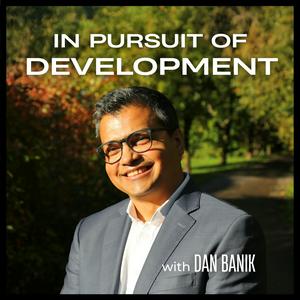
Over In Pursuit of Development
Step into conversations that travel across continents and challenge the way you think about progress. From democracy and inequality to climate resilience and healthcare, Dan Banik explores how societies navigate the complex terrain of democracy, poverty, inequality, and sustainability. Through dialogues with scholars, leaders, and innovators, In Pursuit of Development uncovers how ideas travel, why policies succeed or fail, and what it takes to build a more just and resilient world. Expect sharp insights, candid reflections, and a global perspective that connects local struggles to universal aspirations.
Listen, reflect, and be inspired to see global development in a new light. 🎧
Podcast websiteLuister naar In Pursuit of Development, Betrouwbare Bronnen en vele andere podcasts van over de hele wereld met de radio.net-app
Ontvang de gratis radio.net app
- Zenders en podcasts om te bookmarken
- Streamen via Wi-Fi of Bluetooth
- Ondersteunt Carplay & Android Auto
- Veel andere app-functies
Ontvang de gratis radio.net app
- Zenders en podcasts om te bookmarken
- Streamen via Wi-Fi of Bluetooth
- Ondersteunt Carplay & Android Auto
- Veel andere app-functies

In Pursuit of Development
Scan de code,
download de app,
luisteren.
download de app,
luisteren.
 Netherlands