
Luister gratis naar deze podcast in de app: Gratis downloaden in de App Store
radio.net
Slaaptimer
Favorieten opslaan
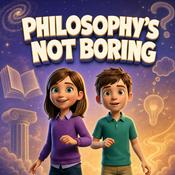
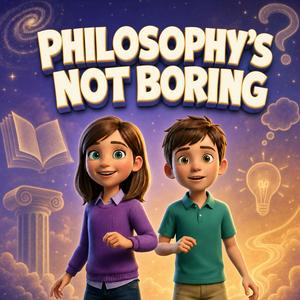
Philosophy for Kids / Philosophy's Not Boring: The Kids Philosophy Podcast
Kidopoly
Nieuwste aflevering
89 afleveringen
What is the purpose of life?
20-10-2026 | 11 Min.Have you ever watched a tiny ant carrying a crumb and wondered... what is it actually doing? What is the point of it all? That little mental jolt you just felt is the biggest question ever asked: What is the purpose of life? In this amazing episode of Philosophy is Not Boring, Mira and Finn go on a global adventure to find the answer!
First, we look at science! Biology tells us our drive is survival, like passing the baton in a giant relay race of life. But human beings do so much more than just survive—we build spaceships and tell ridiculous jokes! That's where philosophers come in! We travel back to Ancient Greece where Aristotle talks about "eudaemonia"—flourishing and growing your mind like a mighty oak tree. Then, we explore the beautiful Southern African philosophy of "Ubuntu," which means we find our purpose by caring for our community and playing as a team! Finally, we travel to Japan to learn about "Ikigai," discovering the sweet spot between what you love doing and what the world needs.
Join us to learn why finding your purpose is an exciting adventure!What is the Spotlight Effect?
19-10-2026 | 11 Min.Have you ever tripped in the cafeteria, spilled your milk, or worn your shirt inside out by accident? Did you feel like the whole world stopped just to stare at you? That terrible feeling is called the Spotlight Effect, and it might just be a giant trick your brain is playing on you! Join Mira and Finn as they explore a brilliant and super funny experiment from the year 2000. Psychologist Thomas Gilovich at Cornell University wanted to know why humans are so self-conscious. He made college students wear the most embarrassing t-shirt imaginable—featuring a giant picture of singer Barry Manilow—and walk into a room full of strangers! The students were absolutely sure everyone was staring and judging them. But the actual results of the study will completely shock you! Discover why people aren't actually secretly laughing at your bad hair days, and how everyone is just busy starring in their own movie! This mind-bending psychology secret will take that heavy invisible backpack off your shoulders and let you just be you. Tune in to find out the truth!What is the Turing Test?
18-10-2026 | 11 Min.Have you ever wondered if your tablet, smartphone, or smart speaker is actually thinking, or just pretending? In this mind-boggling episode of Philosophy is Not Boring, Mira and Finn tackle a massive question: Can a computer think?! Back in 1950, a genius mathematician named Alan Turing decided to stop arguing about what the word "think" means and created a super fun hide-and-seek game instead. It is called the Turing Test! Imagine texting a stranger hidden in another room—could you figure out if they were a real human or a clever robot? But wait, the debate doesn't stop there! In 1980, a philosopher named John Searle came up with a wild thought experiment called "The Chinese Room" to prove that computers do not actually understand anything—they just follow giant, super-fast rulebooks! From giant, noisy vintage computers the size of whole rooms to the very first chatting robot named ELIZA, get ready for an awesome ride through the history of artificial intelligence. Will Finn figure out how to trick his smart speaker? Tune in to find out!What is confirmation bias?
17-10-2026 | 11 Min.Have you ever been absolutely sure you were right about something, only to find out you were totally wrong? Welcome to the ultimate brain trap! In this mind-bending episode of Philosophy is Not Boring, Mira and Finn dive into a sneaky psychological puzzle from 1960. A clever psychologist named Peter Wason challenged people to figure out his secret math rule using the numbers 2, 4, and 6. It sounds super easy, right? But almost everyone failed! Why? Because of a tricky little thing called confirmation bias!
Our brains love to be right, so we usually only look for clues that prove our own ideas and completely ignore everything else. It’s like wearing invisible sunglasses that only let you see what you want to see! Join us as we explore how this sneaky bias works, why we fall into its trap even when arguing with our friends, and how you can develop a mental superpower to beat it. Get ready to discover why the absolute smartest thing you can ever do to find the real truth is to hunt for a "no" and try to prove yourself wrong!Why did religions make food rules?
16-10-2026 | 12 Min.Have you ever wondered why your lunchbox might hold a secret story about the universe? It’s true! For thousands of years, billions of people around the world have followed special rules about what they can and cannot eat. But why? Join Mira and Finn as they explore the fascinating philosophy behind religious food rules! Discover why Jewish people keep Kosher and never mix meat with milk, and what it means for Islamic food to be Halal. We'll travel to ancient India to learn about Ahimsa, a concept where Jain and Hindu believers practice extreme kindness by never eating animals—and sometimes even avoiding potatoes to protect tiny bugs in the dirt! You'll also find out why Buddhist monks in Thailand stop eating solid food after midday, and how Christian traditions like Lent use small sacrifices to focus on big beliefs. It turns out, sharing a food rule is one of the oldest ways humans say, "We belong together." Get ready to turn your ordinary dinner plate into a magical connection spanning the globe!
Meer Kind en gezin podcasts








Trending Kind en gezin -podcasts










Over Philosophy for Kids / Philosophy's Not Boring: The Kids Philosophy Podcast
A groundbreaking podcast for curious kids aged 4-12, and the grown-ups listening with them, that proves philosophy, psychology and religion are anything but dull.Join our fictional AI hosts Mira, a brilliant 9-year-old, and her younger brother Finn, age 7, as they explore philosophy, psychology and religion as one big family of questions about how we make sense of things. Each episode takes a real thinker or idea seriously, from what makes you the same person you were as a baby to why people across the world believe such different things about the soul, and then lands it somewhere in your actual life.We don't hand you the answer and move on. Some questions have one; some have several worth comparing; some nobody has ever settled, and we'll tell you which is which. On matters of faith we stay even-handed: we describe what people believe from the outside, and never tell you what to believe yourself. Because philosophy isn't a pile of hard words to memorize. It's learning to ask a better question, and to sit with it honestly, even when it's uncomfortable.A note on why we use AI. For us, AI allows us to deliver learning at a scale and quality that previously would have been too expensive. If we make the odd technical error, or the sound goes a bit funny, bear with us, we're trying our best. We hope you enjoy the show!
Podcast websiteLuister naar Philosophy for Kids / Philosophy's Not Boring: The Kids Philosophy Podcast, Het Klokhuis en vele andere podcasts van over de hele wereld met de radio.net-app
Ontvang de gratis radio.net app
- Zenders en podcasts om te bookmarken
- Streamen via Wi-Fi of Bluetooth
- Ondersteunt Carplay & Android Auto
- Veel andere app-functies
Ontvang de gratis radio.net app
- Zenders en podcasts om te bookmarken
- Streamen via Wi-Fi of Bluetooth
- Ondersteunt Carplay & Android Auto
- Veel andere app-functies

Philosophy for Kids / Philosophy's Not Boring: The Kids Philosophy Podcast
Scan de code,
download de app,
luisteren.
download de app,
luisteren.
Philosophy for Kids / Philosophy's Not Boring: The Kids Philosophy Podcast: Podcasts in familie

 Netherlands

