

Luister gratis naar deze podcast in de app: Gratis downloaden in de App Store
radio.net
Slaaptimer
Favorieten opslaan
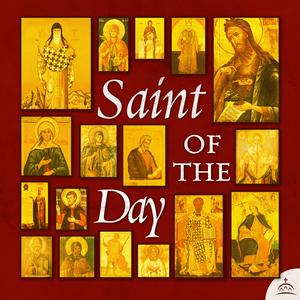
Saint of the Day
Dn. Jerome Atherholt, and Ancient Faith Ministries
Nieuwste aflevering
6071 afleveringen
Holy Righteous Martyr Paraskeve (140)
26-07-2026She was born near Rome to pious parents. Since she was born on a Friday, she was named Paraskeve (Friday in Greek; literally "preparation" or "preparedness" because Friday was the Biblical Day of Preparation for the Sabbath). From early childhood she studied the scriptures, consecrated herself to a monastic life, and brought many to faith in Christ by her example and teaching. During the reign of Antoninus she was arrested because she was a Christian. When ordered to worship the idols, she answered "Let the gods that have not made heaven and the earth perish from off the earth" (Jeremiah 10:11). For this, after severe tortures she was beheaded in 140.St Olympias the Deaconess (408)
25-07-2026She was born to a noble family in Constantinople: her father Anysius Secundus was a senator. She was betrothed to a nobleman who died before they could be wed; resisting all advice to take another husband, Olympias devoted herself entirely to God, giving her large inheritance to the Church and to the poor. She served as a deaconess, first under the Patriarch Nektarios, then under St John Chrysostom. When St John was sent into exile, he advised her to remain in Constantinople, and to continue to serve the Church whatever patriarch took his place. But as soon as the holy hierarch went into exile, a fire destroyed a large part of the City, and St John's enemies accused the holy Olympias of setting the fire. She in turn was exiled to Nikomedia, where she reposed in 408. She left instructions that her body be placed in a coffin and thrown into the sea, to be buried wherever it was cast up. The coffin came to shore at Vrochthoi and was buried there at a church dedicated to the Apostle Thomas. Her relics have continued to be a source of great miracles of healing.
During his exile, St John Chrysostom wrote a number of letters to St Olympias, seventeen of which have been preserved through the centuries. In one he writes: 'Now I am deeply joyful, not only because you have been delivered from sickness, but even more because you are bearing adversities with such fortitude, calling them trifles — a characteristic of a soul filled with power and abounding in the rich fruits of courage. You are not only enduring misfortune with fortitude, but are making light of it in a seemingly effortless way, rejoicing and triumphing over it — this is a proof of the greatest wisdom.'Martyr Christina of Tyre (200)
24-07-2026She was from Tyre in Syria, the daughter of a pagan named Urban. She is a miraculous example of one brought to faith in Christ without any human intervention. When she was about eleven years old, her father, seeing her great beauty and wanting to protect her from men until she was grown, made her live alone on the top floor of a fine house, with slaves, all worldly comforts, and gold and silver idols. Passing the time by looking out the window, Christina came by her meditations on the beauty and order of nature to believe in the one, living God. An Angel of the Lord then came to her, who marked her with the sign of the Cross and instructed her in the truth of the Gospel. The newly-enlightened Christina smashed all the idols in her room, so infuriating her father that he sent her to be tortured and beheaded for her faith. Her father, though in good health and in the prime of life, died that night. Christina was subjected to horrible tortures and mutilations, and finally died by the sword, her faith unshaken.
Troparion to St Christina: O Lord Jesus, unto Thee Thy lamb doth cry with a great voice:* O my Bridegroom, Thee I love;* and seeking Thee, I now contest, and with Thy baptism am crucified and buried.* I suffer for Thy sake, that I may reign with Thee;* for Thy sake I die, that I may live in Thee:* accept me offered out of longing to Thee as a spotless sacrifice.* Lord, save our souls through her intercessions,* since Thou art great in mercy.Hieromartyr Apollinarius, bishop of Ravenna (75)
23-07-2026He was a disciple of St Peter, born in Antioch. St Peter took him to Rome (he was bishop of Antioch before being bishop of Rome, so Antioch is as much the 'see of Peter' as is Rome) and made him Bishop of Ravenna. In Ravenna, he healed the wife of the military governor of a grave illness, after which the governor and his household confessed Christ and were baptized. Apollinarius was able to form a house church in the governor's home, from which he labored for the Gospel for twelve years. Eventually, he was condemned to exile in Illyria for his faith, and began a life of missionary travel in the Balkans, travelling as far as the Danube. After twelve years of this work, he was driven back to Italy by the hostility of some of the pagans. He was received with joy by the people of Ravenna, which aroused the envy of the pagan elders, who denounced him to the Emperor Vespasian. When the elders asked permission to kill Apollinarius, the Emperor only gave them permission to drive him from the city, wisely saying 'It is not seemly to take revenge on behalf of the gods, for they can themselves be revenged on their enemies if they are angered.' But, in defiance of the Imperial decree, the pagan leaders attacked and killed Apollinarius with knives. His holy relics are preserved in Ravenna, in a church dedicated to him.Holy Myrrh-bearer and Equal-to-the-Apostles Mary Magdalene
22-07-2026She was from the town of Magdala on the Sea of Galilee, for which reason she is called "Magdalene." The Lord Jesus cast out seven demons from her, after which she became His faithful disciple, following Him even to the Cross when most of His disciples had fled. With the other holy Myrrh-bearers, she prepared the spices to anoint His body and carried them to His tomb. There she was one of the first witnesses to the Resurrection, and the first to proclaim it.
Various traditions hold that, after Christ's ascension, she traveled to Rome, where she presented the Emperor with a red egg and proclaimed "Christ is Risen!" For this reason her icons often show her holding a red egg, and from this the tradition of distributing red eggs at Pascha is said to have arisen. She is then said to have travelled to Ephesus where she helped St John the Theologian in his gospel ministry before reposing there.
Mary Magdalene is sometimes identified with the "sinful woman" of the Gospels, but this is not the Church's tradition. Neither the Gospels nor the sacred hymnography of the Church make this connection.
The name 'Madeleine' is a form of 'Magdalene'.
Meer Christendom podcasts
 Heilige van de DagChristendom, Geschiedenis, Religie en spiritualiteit
 Christine en Gerjanne weten het (ook niet)Christendom, Religie en spiritualiteit
 Dit is de BijbelChristendom, Religie en spiritualiteit
 Dick en Daniël Geloven het WelChristendom, Religie en spiritualiteit
 De Ongelooflijke PodcastChristendom, Religie en spiritualiteit, Spiritualiteit
 Dick en Daniël Geloven het WelChristendom, Religie en spiritualiteit
 Een preek voor elke dagChristendom, Onderwijs, Religie en spiritualiteit
 Bijbel in een jaarChristendom, Religie en spiritualiteit
 Zij Lacht - Elke DagChristendom, Religie en spiritualiteit
 Timothy Keller Sermons Podcast by Gospel in LifeChristendom, Religie en spiritualiteit
Trending Christendom -podcasts
 Bijbellezen met JanBoeken, Christendom, Cursussen, Kunst, Onderwijs, Religie en spiritualiteit
 The Book of Revelation: Bible StudyChristendom, Religie en spiritualiteit
 Elevation with Steven FurtickChristendom, Religie en spiritualiteit
 Hour of Power NLChristendom, Religie en spiritualiteit
 BijbelbreinChristendom, Kind en gezin, Onderwijs voor kinderen, Opvoeding, Religie en spiritualiteit
 Jentezen Franklin at Free ChapelChristendom, Religie en spiritualiteit
 Exploring My Strange BibleChristendom, Filosofie, Gezondheid en fitness, Maatschappij & cultuur, Religie en spiritualiteit
 De Wereld RondChristendom, Religie en spiritualiteit
 Bethel Redding Sermon of the WeekChristendom, Religie en spiritualiteit
 LuisterbijbelChristendom, Religie en spiritualiteit
 2819 ChurchChristendom, Religie en spiritualiteit
 Saved Not SoftChristendom, Religie en spiritualiteit
- Zij Lacht - Elke DagChristendom, Religie en spiritualiteit
 Things Unseen with Sinclair B. FergusonChristendom, Religie en spiritualiteit
 Christelijke ApologeetChristendom, Religie en spiritualiteit
 Theologie aan de grachtChristendom, Religie en spiritualiteit
Over Saint of the Day
Daily Orthodox Saints
Podcast websiteLuister naar Saint of the Day, Heilige van de Dag en vele andere podcasts van over de hele wereld met de radio.net-app
Ontvang de gratis radio.net app
- Zenders en podcasts om te bookmarken
- Streamen via Wi-Fi of Bluetooth
- Ondersteunt Carplay & Android Auto
- Veel andere app-functies
Ontvang de gratis radio.net app
- Zenders en podcasts om te bookmarken
- Streamen via Wi-Fi of Bluetooth
- Ondersteunt Carplay & Android Auto
- Veel andere app-functies

Saint of the Day
Scan de code,
download de app,
luisteren.
download de app,
luisteren.
 Netherlands