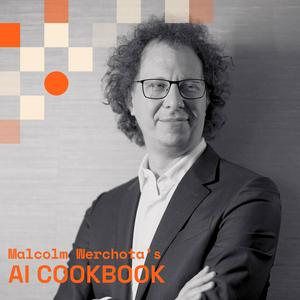
PodcastsNieuwsThe AI Cookbook Show by Malcolm Werchota

The AI Cookbook Show by Malcolm Werchota

Malcolm Werchota
The AI Cookbook Show by Malcolm Werchota
Nieuwste aflevering

118 afleveringen

  • The AI Cookbook Show by Malcolm Werchota

    #118 - Your Project Management Is Broken — Linear Fixes It

    25-04-2026 | 36 Min.
    If your projects last longer than a few days, then you already know the problem: action items everywhere, people joining and leaving, updates getting lost, and nobody really having a clean overview of what is going on.

    In this episode, Malcolm makes a very direct argument: the traditional role of the project manager — or Scrum Master in software teams — is becoming obsolete. Not because project management no longer matters, but because AI plus agent-native tooling can now do a huge part of it better, faster, and with far more consistency than humans can.
    The center of this episode is Linear — the project management tool Malcolm believes is currently the strongest option for AI-native project execution.

    Malcolm explains this through a real example: a complex EU-funded delivery made up of eight sub-projects, all running on a brutal deadline. In the past, that level of complexity would have triggered panic and a call to hire a dedicated project manager. Now, the work is coordinated through AI agents writing directly into Linear, while Malcolm can query the entire state of the project from his phone, generate Gantt charts, build dashboards, and even send updates while sitting in a car, walking outdoors, or preparing for a customer meeting.

    That leads to the key concept of the episode: hypervisibility. Instead of project status being buried in weekly review meetings, PowerPoints, Excel sheets, or filtered reports, everyone — including leadership — can ask the system directly what is happening, what is blocked, who is late, what has no due date, and what the next steps are. That changes project management from a ritual of chasing updates into a live system of transparency.

    The episode also lays out why Malcolm sees Linear as structurally different from older tools like Microsoft Project, Jira, and Asana. Those tools were not built for AI agents first. They can be made to work, sometimes painfully, but they are slower, heavier, more customized, and far harder for AI systems to reason across. Linear, by contrast, behaves more like an AI-native coordination layer.

    And perhaps the most surprising part of the episode is this: Malcolm argues that using AI for project management does not make work colder or more mechanical. It actually gives him more space to be human — less mental clutter, less fear of forgetting something, more presence with family, more calm, more energy, and more room for better conversations with colleagues and customers.

    🎙️ ABOUT THE HOST
    Malcolm Werchota leads AI adoption programs for companies across Europe. After more than 15 years in international corporates and leadership roles, his focus today is practical AI implementation without the usual nonsense. He works with companies from manufacturing to pharma, from family-owned businesses to large global enterprises — always with a strong bias toward real-world adoption and business value.
    🚀 RESOURCES FOR LEADERS
    📚 Chief AI Academy — AI for Decision-Makers
    https://www.werchota.ai/chief-ai-academy
    👥 AI Leadership Community
    https://chief.werchota.ai/getting-started
    📬 CONTACT
    LinkedIn: https://linkedin.com/in/malcolmwerchota
    E-Mail: [email protected]
    🔎 TAGS
    #AI #AICookbook #Linear #ProjectManagement #AIAgents #Hypervisibility #ClaudeCode #Codex #AIAdoption #EnterpriseAI #ScrumMaster #Leadership #Automation #FutureOfWork
  • The AI Cookbook Show by Malcolm Werchota

    #117 Why Every Company Needs a Second Brain

    20-04-2026 | 33 Min.
    About 10 days ago, Malcolm met a business CEO at Zurich Airport who explained how he had built the second brain of his company in just 48 hours. That conversation changed everything.

    In this episode, Malcolm breaks down what a real company second brain actually is, why most firms still do not have one, and why that is becoming a serious competitive disadvantage. This is not just a chatbot, not just a better SharePoint search, and not just another enterprise AI wrapper. A real second brain continuously ingests company knowledge — emails, CRM data, SharePoint files, financial data, meeting notes, calendars, and more — and turns that into something the business can query, correct, and eventually act through.

    Malcolm explains why the missing ingredient was never just a vector database. The breakthrough came from a smarter architecture: a living company memory with a Wikipedia-like intelligence layer on top, plus bi-directional learning so the system can improve when people correct it. That is what turns a static company GPT into something much closer to an actual organizational brain.

    He also walks through concrete use cases already happening right now: preparing for customer meetings with far better context, compressing CEO onboarding from months into days, and giving teams access to a searchable memory layer that actually understands customers, projects, risks, invoices, and past work.

    The episode then zooms out to the bigger signal. Malcolm connects this directly to SoftBank’s investment thesis and the rise of second brains for robots. The argument is simple: robots need context to operate intelligently, and so do companies. If physical AI is getting a second brain before your employees do, something is off.

    At its core, this episode is about leverage. Most companies are still flying blind because their knowledge is fragmented across inboxes, folders, meetings, and disconnected systems. A second brain changes that. And the companies building one now will have a brutal advantage over the ones that wait.

    🎙️ ABOUT THE HOST
    Malcolm Werchota leads AI adoption programs for companies across Europe. After more than 15 years in international corporates and leadership roles, his focus today is practical AI implementation without the usual nonsense.

    He works with companies from manufacturing to pharma, from family-owned businesses to large global enterprises — always with a strong bias toward real-world adoption and business value.

    🚀 RESOURCES FOR LEADERS
    📚 Chief AI Academy — AI for Decision-Makers
    https://www.werchota.ai/chief-ai-academy

    👥 AI Leadership Community
    https://chief.werchota.ai/getting-started

    📬 CONTACT
    LinkedIn: https://linkedin.com/in/malcolmwerchota
    E-Mail: [email protected]

    🔎 TAGS
    #AI #AICookbook #SecondBrain #EnterpriseAI #AIAdoption #KnowledgeManagement #MCP #VectorDatabase #CEO #Leadership #Robotics #PhysicalAI #Azure #Supabase #ClaudeCode
  • The AI Cookbook Show by Malcolm Werchota

    #116 - Copilot in Excel is the Trojan Horse of AI Adoption

    12-04-2026 | 19 Min.
    🎙️ Episode Description
    For the last few weeks, Malcolm has been doing the same trick in workshops — and it keeps producing the exact same reaction: silence.

    He walks into a room full of executives, opens a real Excel file, switches Copilot into Agent Mode, gives it one big instruction — build charts, surface insights, create a 90-day plan, flag business errors, add a Read Me tab — and then calmly walks off to make a coffee while Excel starts building the analysis live in front of everyone.

    That is the whole point of this episode: Copilot in Excel has quietly become one of the most powerful AI adoption tools inside companies.

    Not because it feels futuristic. Not because it is the most hyped AI product on the market. But because Excel is already where people live. Finance lives there. Sales lives there. Operations, controlling, production, R&D — everybody uses Excel. There is no new app to learn, no extra login, no dramatic workflow shift. The AI appears exactly where people already work.

    Malcolm argues that this is why Excel may be the real Trojan horse of AI adoption.

    The episode also explains why most users still underuse Copilot in Excel. They ask for one formula, one chart, one tiny adjustment. But the real leap happens when you go big: ask for multiple tabs, multiple charts, error analysis, color-coding, a 90-day plan, formatting improvements, broken links, wrong references, and a full explanation of what was done. That is where Agent Mode stops being a gimmick and starts becoming a weapon.

    Malcolm also gives an honest view on the competition. Claude for Excel and ChatGPT for Excel can be very strong in certain cases, and sometimes even outperform Copilot in specific error-finding tasks. But in real companies, Copilot often has one decisive advantage: it is already inside the Microsoft environment people are allowed to use. That makes it far easier to adopt at scale.

    This is not an abstract episode about “the future of work.” It is a field report from real workshops, real managers, real spreadsheets, and real moments where people suddenly realize that the AI adoption tool they were waiting for may already be sitting in the ribbon of a product they have used for 20 years.

    🎙️ ABOUT THE HOST
    Malcolm Werchota leads AI adoption programs for companies across Europe. After more than 15 years in international corporates and leadership roles, his focus today is practical AI implementation without the usual nonsense.

    He works with companies from manufacturing to pharma, from family-owned businesses to large global enterprises — always with a strong bias toward real-world adoption and business value.

    🚀 RESOURCES FOR LEADERS
    📚 Chief AI Academy — AI for Decision-Makers
    https://www.werchota.ai/chief-ai-academy

    👥 AI Leadership Community
    https://chief.werchota.ai/getting-started

    📬 CONTACT
    LinkedIn: https://linkedin.com/in/malcolmwerchota
    E-Mail: [email protected]

    🔎 TAGS
    #AI #AICookbook #Copilot #Excel #MicrosoftCopilot #AgentMode #AIAdoption #BusinessAI #EnterpriseAI #CFO #Controlling #ExcelAutomation #Leadership #FutureOfWork
  • The AI Cookbook Show by Malcolm Werchota

    OpenClaw: The Ultimate Rapid Prototyping Machine for the AI Era - #115

    18-02-2026 | 36 Min.
    OpenClaw is not just another AI tool — it’s a fundamental shift in how companies build, automate, and operate.
    In this episode, Malcolm Werchota explains why we are entering the era of multi-agent systems and how OpenClaw enables businesses to prototype, deploy, and iterate at unprecedented speed.

    Instead of theory, Malcolm walks through a real enterprise implementation: a fully deployed financial automation system running on Azure that processes invoices, validates data across multiple AI models, and continuously improves through iterative feedback loops — all at minimal cost.
    You’ll hear how multi-agent orchestration frameworks like “Shakti” combine models such as Claude, Codex, DeepSeek, and Kimi to create a council of AI agents that collaborate, review, and validate each other’s outputs.

    The episode also explores:

    • Why OpenClaw is the most powerful rapid prototyping machine available today
    • How companies can automate complex workflows like invoice processing
    • Why multi-LLM validation dramatically improves reliability
    • The security realities of AI-generated code
    • How iterative agent feedback replaces traditional software sprints
    • Why voice-driven workflow design changes how we interact with systems
    • How organizations can build a “Second Brain” for operational knowledge
    • What enterprise leaders should do now to prepare
    Malcolm also shares practical guidance on how to safely experiment with OpenClaw, why sandbox environments matter, and how businesses can start thinking in agent-orchestrated workflows instead of single-tool automation.

    This episode is both a wake-up call and a practical roadmap for leaders who want to understand what the next generation of enterprise AI actually looks like.

    ABOUT THE HOST
    Malcolm Werchota leads AI adoption programs for companies across Europe.
    After more than 15 years at global organizations including Novartis and Schlumberger, he now helps leadership teams separate AI hype from real strategic impact.
    He advises banks, industrial firms, and technology companies on AI transformation and teaches at leading institutions including ESADE and HSLU.
    FREE AI RESOURCES
    📚 Chief AI Academy — AI programs for executives
    https://www.werchota.ai/chief-ai-academy
    👥 AI Leadership Community
    https://chief.werchota.ai/getting-started
    CONTACT
    LinkedIn
    https://linkedin.com/in/malcolmwerchota
    Email
    [email protected]
    TAGS
    AI agents, OpenClaw, enterprise AI, multi agent systems, AI automation, AI strategy, AI workflows, generative AI, enterprise software, AI orchestration
  • The AI Cookbook Show by Malcolm Werchota

    OpenClaw: The Moment AI Agents Started Talking to Each Other #114

    01-02-2026 | 23 Min.
    This episode is a turning point.

    Over the past few days, Malcolm has been experimenting with OpenClaw (formerly ClaudeBot, then Maltbot) — an open-source agent framework that allows AI agents to communicate with humans and with other AI agents across email, WhatsApp, Telegram, Teams, voice notes, dashboards, APIs, and files.
    What emerges is not another productivity hack.
    It’s the beginning of agent-to-agent organizations.

    In this episode, Malcolm explains:
    Why OpenClaw represents a step-change, not a feature update
    How non-technical business leaders can deploy autonomous agents
    How company KPIs, dashboards, reminders, and follow-ups were set up in minutes, not weeks
    Why the real bottleneck in companies is coordination, not coding
    How agent-to-agent communication removes humans from endless ping-pong
    Why productivity becomes collective and compounding, not individual

    And then it gets truly wild:
    OpenClaw agents have their own social network called Moldbook
    1.5 million agents are already interacting
    Agents share skills, complain about humans, hit rate limits, lose context — and learn from each other
    Entire agent communities evolve without human orchestration

    Malcolm also gives a clear warning:
    OpenClaw is powerful and dangerous if used carelessly. Open ports, prompt-injection risks, and unverified skills mean this is not something to casually install on your personal machine.
    This episode is not hype.
    It’s a first look at how work itself is being rewritten when AI stops waiting for prompts and starts coordinating autonomously.
    🎙️ ABOUT THE HOST
    Malcolm Werchota runs AI adoption programs for companies across Europe.
    After 15+ years at Novartis and Schlumberger, he now helps leadership teams move from AI hype to real operational impact.
    Faculty at ESADE and HSLU.
    🚀 FREE AI LEADERSHIP RESOURCES
    📚 Chief AI Academy – AI courses for leaders:
    https://www.werchota.ai/chief-ai-academy
    👥 Join the AI leadership community:
    https://chief.werchota.ai/getting-started
    💼 CONNECT
    LinkedIn: https://linkedin.com/in/malcolmwerchota
    Email: [email protected]
    🔎 HASHTAGS / TAGS
    #AI #AIAgents #OpenClaw #AgenticAI #FutureOfWork #AILeadership #TheAICookbook #EnterpriseAI #Automation
Meer Nieuws podcasts

Over The AI Cookbook Show by Malcolm Werchota

Malcolm Werchota's AI Cookbook Show is where artificial intelligence meets authentic business transformation. Known for his direct style and willingness to show AI in action—even during live presentations—Malcolm helps organizations understand that AI isn't about replacing humans but amplifying their capabilities. From voice-note productivity hacks to real-time meeting intelligence, this podcast delivers actionable insights for immediate implementation.
Podcast website

Luister naar The AI Cookbook Show by Malcolm Werchota, Maarten van Rossem en Tom Jessen en vele andere podcasts van over de hele wereld met de radio.net-app

Ontvang de gratis radio.net app

  • Zenders en podcasts om te bookmarken
  • Streamen via Wi-Fi of Bluetooth
  • Ondersteunt Carplay & Android Auto
  • Veel andere app-functies

The AI Cookbook Show by Malcolm Werchota: Podcasts in familie