
Luister gratis naar deze podcast in de app: Gratis downloaden in de App Store
radio.net
Slaaptimer
Favorieten opslaan
311 afleveringen
Questions and Answers Episode 61
17-10-2026 | 47 Min.In this Old Front Line Q&A, we explore four fascinating questions from the First World War, taking us from the Ypres Salient to German-occupied France and Belgium, and from wartime prisoners to the fate of battlefield cemeteries during the Second World War.
We begin in the Ypres Salient and the often-overlooked French presence in 1914–15. When did French troops arrive, how was the Allied sector divided, why did the British eventually take over, and what was the relationship between French and British soldiers on the Western Front?
We then investigate the experience of British officers who became prisoners of war. Were former POWs really interrogated by British military authorities after 1918, and what happened when they returned home?
Our third question takes us behind the German lines to examine everyday life for French and Belgian civilians under occupation. How did German rule affect schools, currency, local government, communication and families separated by the new front line?
Finally, we look at the impact of the Second World War on First World War cemeteries, memorials and battlefields. Were Great War sites deliberately targeted, accidentally damaged or protected? And what is the truth behind the story of Hitler and the Canadian Memorial at Vimy Ridge?
Main Image: British Officer Prisoners of war in Germany c.1916. (OFL Archives).
Sign up for the free podcast newsletter here: Old Front Line Bulletin.
You can order Old Front Line Merch via The Old Front Line Shop.
Got a question about this episode or any others? Drop your question into the Old Front Line Discord Server or email the podcast.
Send us Fan Mail
Support the showThe Missing of 1914
10-10-2026 | 45 Min.Between August and December 1914, the British Expeditionary Force fought its first battles of the First World War across Belgium and northern France and some 19,000 officers and men were missing. From Mons and Le Cateau to the Retreat and the First Battle of Ypres, thousands of men were killed and never recovered, becoming part of the great story of the Missing of 1914.
In this episode of The Old Front Line, we explore the history behind the 1914 campaign and discuss the memorials that commemorate those who have no known grave and who died in 1914. But this time, we go beyond the just the names by using a specially developed AI tool.
With this we analyse the data behind the Missing of 1914 to uncover patterns and statistics: which were the costliest days of the campaign, which regiments suffered the greatest losses, how old were the men who disappeared, where did they come from, and how many had previous military experience?
By combining battlefield history, memorials, military records and data analysis with the expert eye of an historian, we take a different look at the men who went missing during those iconic opening months of the First World War.
Main Image: La Ferte sous Jouarre Memorial (Old Front Line Archives).
Sign up for the free podcast newsletter here: Old Front Line Bulletin.
You can order Old Front Line Merch via The Old Front Line Shop.
Got a question about this episode or any others? Drop your question into the Old Front Line Discord Server or email the podcast.
Send us Fan Mail
Support the showQuestions and Answers Episode 60
03-10-2026 | 44 Min.In this episode of The Old Front Line Podcast, we answer another fascinating selection of listener questions that explore the realities of life, death, remembrance and battlefield tactics on the Western Front during the First World War.
How much safer were soldiers when they left the front line? We examine the British Army's system of rotating troops through front-line, support and reserve positions, and ask whether moving away from the trenches really improved a soldier's chances of survival, or whether artillery, snipers and long-range shellfire meant danger was never far away.
We also travel to Sidcup in Kent and explore the legacy of families who suffered devastating losses during the Great War. From the pioneering work of Sir Harold Gillies and the famous "blue benches" to the story of the Crombie family, we investigate whether Britain had its own "Saving Private Ryan" stories and look at families who lost multiple sons in the conflict.
A visit to Hooge Crater Cemetery prompts a question about multiple burials in Commonwealth War Graves Commission cemeteries. Why do some headstones commemorate several men? How common are collective graves, and what do they tell us about the conditions of battle and battlefield burial?
Finally, we delve into the world of breastwork trenches. Common across the low-lying landscapes of French Flanders, these unusual battlefield defences posed unique challenges for attackers and defenders alike. How were breastworks built, assaulted and protected, and were they more vulnerable to artillery fire than conventional trenches?
Book Recommendations:
Roy, R.H. - The Journal of Private Fraser (Canada 1985, later CEF books 1998)
Dr Lindsey Fitzharris - The Facemaker (London 2022)
Main Image: New Zealand troops of the 9th (Wellington East Coast Rifles) Regiment holding a well constructed breastwork near Fleurbaix during June 1916. Note one of the troops using a periscope rifle. (IWM Q666).
Sign up for the free podcast newsletter here: Old Front Line Bulletin.
You can order Old Front Line Merch via The Old Front Line Shop.
Got a question about this episode or any others? Drop your question into the Old Front Line Discord Server or email the podcast.
Send us Fan Mail
Support the showSomme: Mighty Thiepval
26-09-2026 | 1 u. 7 Min.The Thiepval Memorial to the Missing is the largest British war memorial in the world and one of the most powerful places where we remember the sacrifice of the Missing on the Western Front. In this episode, we explore the story behind "Mighty Thiepval" and uncover why this iconic monument continues to resonate more than a century after the Battle of the Somme.
We begin by examining the strategic importance of the village of Thiepval during the fighting up to 1916, and why it became one of the most heavily defended positions on the battlefield. We then follow the remarkable career of Sir Edwin Lutyens, tracing the experiences and influences that led him to create this masterpiece of remembrance.
Using modern AI technology, we delve into the stories hidden within the more than 72,000 names carved into the memorial's stonework, revealing what these men can tell us about the scale and human cost of the Somme campaign. Along the way, we focus on several individual soldiers whose lives and sacrifices help bring the memorial's vast roll of honour into sharper focus.
Finally, we take a walk across the battlefield at Thiepval today, exploring the landscape, the surviving traces of war, and the enduring connection between memory, history and place.
Main Image: Thiepval Memorial during the WW1 Centenary.(Old Front Line archives)
Sign up for the free podcast newsletter here: Old Front Line Bulletin.
You can order Old Front Line Merch via The Old Front Line Shop.
Got a question about this episode or any others? Drop your question into the Old Front Line Discord Server or email the podcast.
RECOMMENDED READING:
Lutyens and the Great War - Tim Skelton and Gerald Gliddon (Frances Lincoln 2008)
Cemeteries of the Great War by Sir Edwin Lutyens - Jeroen Geurst (Rotterdam 2010)
The Memorial to the Missing of the Somme - Gavin Stamp (Profile 2006)
Send us Fan Mail
Support the showQuestions and Answers Episode 59
19-09-2026 | 46 Min.In this latest Old Front Line Q&A, we tackle four fascinating questions that take us from the opening moments of the Battle of the Somme to the long legacy of the Western Front landscape.
We begin at Hawthorn Ridge on 1 July 1916 and ask whether the famous mine was detonated ten minutes early to help the attack, to provide Geoffrey Malins with the perfect filming opportunity, or for a combination of both. We also examine whether the advanced position of the Lancashire Fusiliers in the Sunken Lane, together with the early gains of the Ulster Division nearby, could have transformed a disastrous sector of the Somme battlefield into a genuine British success.
We then explore memories of the Second World War, discussing whether First World War veterans ever compared their own experiences with the rapid collapse of France and the BEF in 1940.
A question inspired by a walk along the Old Front Line looks at modern ownership of battlefield land. If your house stands on top of a trench system, can you excavate it, and what permissions might be required in France and Belgium?
Finally, we examine what happened when soldiers' remains were discovered in the 1920s. How were they identified, who carried out the work, and what kind of burial and ceremony followed?
Book: Nick and Fiona Jenkins - Walking The Line (Wetsocks Books 2021)
Main Image: Field Marshal Montgomery reads the inscription on a grave at the Canadian First World War memorial at Vimy Ridge, 8 September 1944. (IWM BU 763).
Sign up for the free podcast newsletter here: Old Front Line Bulletin.
You can order Old Front Line Merch via The Old Front Line Shop.
Got a question about this episode or any others? Drop your question into the Old Front Line Discord Server or email the podcast.
Send us Fan Mail
Support the show
Meer Filmgeschiedenis podcasts






Trending Filmgeschiedenis -podcasts


Over The Old Front Line
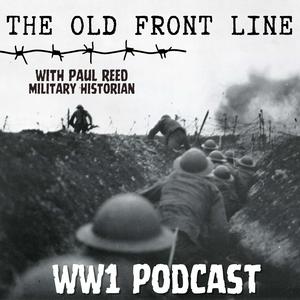
Walk the battlefields of the First World War with Military Historian, Paul Reed. In these podcasts, Paul brings together over 40 years of studying the Great War, from the stories of veterans he interviewed, to when he spent more than a decade living on the Old Front Line in the heart of the Somme battlefields.
Podcast websiteLuister naar The Old Front Line, WHAT WENT WRONG en vele andere podcasts van over de hele wereld met de radio.net-app
Ontvang de gratis radio.net app
- Zenders en podcasts om te bookmarken
- Streamen via Wi-Fi of Bluetooth
- Ondersteunt Carplay & Android Auto
- Veel andere app-functies
Ontvang de gratis radio.net app
- Zenders en podcasts om te bookmarken
- Streamen via Wi-Fi of Bluetooth
- Ondersteunt Carplay & Android Auto
- Veel andere app-functies

The Old Front Line
Scan de code,
download de app,
luisteren.
download de app,
luisteren.
The Old Front Line: Podcasts in familie
 Netherlands