
Luister gratis naar deze podcast in de app: Gratis downloaden in de App Store
radio.net
Slaaptimer
Favorieten opslaan
180 afleveringen
Why Is Everyone So Tired Right Now? How Awe Shrinks Worry
11-10-2026 | 18 Min.Why is everyone so tired right now? Not sleepy, world tired. Too much is changing too fast, our minds never come with an off switch, and we stay busy so we don't have to feel it.
Support me with a coffee and join my Weekly Calm every Sunday: stevenwebb.uk
Ask almost anyone how they are this week and listen to the first word. Tired. More than seven in ten American adults feel very tired or exhausted at least some days, and nine in ten adults in Britain felt high stress or pressure in the past year. Alvin Toffler saw it coming in 1970, before phones in our pockets and news all day long. Your body can be on the sofa while your mind is still on its feet, keeping watch. Busy works like a painkiller, so the moment we stop, it all arrives at once. We can't slow the world down, so I talk about a word I don't think I've ever used on this podcast. Awe. When we feel small in a good way, our worries get smaller too. Months after I broke my neck, they pushed me outside for fifteen minutes. All I could see was a car park, but the cold air on my lungs, wow. I went back to bed and slept for 24 hours.
One thing to try: This week, spend one minute with something bigger than you. The sky, the sea, an old tree, or the dust dancing in a patch of sunlight. Don't name it, don't fix it. Just look, and let it be big.
In this episode
(0:00) Ask anyone how they are, and the first word is tired
(2:23) Alvin Toffler's Future Shock, written in 1970
(3:58) Your body's on the sofa, your mind's still on its feet
(4:56) Being busy works like a painkiller
(7:03) The word I've never used on this podcast: awe
(9:06) Months on a ward, then fifteen minutes in a car park
(12:24) The one minute practice
(14:08) Marcus Aurelius: is this necessary?
With gratitude to
Kasia, Jane, Christine, Danielle, Lindsey, Katherine, Vicki, Fiona, Rebecca and Lorna. A warm welcome to Raquel and Jane, my newest monthly supporters, and thank you to Jenna and Mia for raising theirs.
The companion meditation: Wisdom Within the Storm: A Meditation for Chaotic Times
Support the podcast and join the Weekly Calm: stevenwebb.uk
Thank you for listening.
Steven
Links to Steven Webb's podcast and how you can support his work.
Free book: 5 Simple Practices for Inner Peace. Yours when you join my Weekly Calm.Overwhelmed by the News: Caring Without Drowning
04-10-2026 | 14 Min.How do you care about what's happening in the world without it dragging you under? Practice first, news second. Then do one small thing and put it down.
Support me with a coffee and join my Weekly Calm every Sunday: stevenwebb.uk
The night I broke my neck, I only had to get through the next breath. My family were stood in the corridor with nothing to do, not knowing if I'd see the morning. That's the harder seat, and now we're all sat in it, every day, on a phone. Our hearts were built for a village, not 24 hour news. After the Boston bombing, people who watched six hours of coverage a day were more stressed than some of the people who were actually there. I'm a terrible news junkie myself, so I talk about the feed I keep deleting and putting back, Sid Owen from EastEnders, and why the brain can't tell the telly from a war zone. Underneath the anger there's usually a deep caring. The way through isn't caring less.
One thing to try: Before you scroll in the morning, sit quietly for ten minutes and write a small gratitude list. Then read the news, let yourself feel it, do the one small thing if there is one, and put it down.
In this episode
(0:03) The night I broke my neck, and my family in the corridor
(1:31) Our hearts were built for a village
(2:07) The Boston bombing study: six hours of news a day
(4:50) The brain can't tell the telly from a war zone
(6:14) Caring without drowning: what you can do at arm's length
(7:32) Under the anger there's a deep caring
(9:51) Rabbi Tarfon: you can't finish the work, but you can't walk away
(10:55) Thomas Merton and the frenzy of the activist
With gratitude to
Tamsyne, Bridie, Orsolya, Paul, Ciaran, Cynthia, Sarpa, Jens, Linda and Genevieve
The companion meditation: When the News Is Too Much: A Meditation to Care and Still Rest
Support the podcast and join the Weekly Calm: stevenwebb.uk
Thank you for listening.
Steven
Links to Steven Webb's podcast and how you can support his work.
Free book: 5 Simple Practices for Inner Peace. Yours when you join my Weekly Calm.We're All Terrible Meditators: The Art of Doing Nothing on Purpose
20-09-2026 | 17 Min.Are you bad at meditating? So is everyone. The mind wanders because that is its job. Meditation is not quieting it, it is noticing you have gone and coming back.
Support me with a coffee and join my Weekly Calm every Sunday: stevenwebb.uk
When I started, I thought meditation was sit down, be quiet, no thoughts, pure bliss. It lasted about 30 seconds. Then a teacher gave me the only instruction that ever worked: just sit and do nothing. His version had four letters. Your body knows how to breathe and your mind knows how to go quiet. The job is getting out of their way. Think of a snow globe. To settle the snow you do nothing, you just watch, and life will shake it up again anyway. Every time the mind wanders it is a happy accident, as Bob Ross would say. Smile, say thank you mind, and come back.
One thing to try: Get somewhere five minutes early and just sit in the car. Each time you catch the mind off in a story, smile, say thank you mind, and come back to what you can hear and feel. Five minutes, twice a day.
In this episode
(0:03) Winnie the Pooh, and why meditation is doing nothing on purpose
(1:19) The only instruction that ever worked: just sit and do nothing (his had four letters)
(2:22) The snow globe. To settle the snow, you do nothing
(3:45) You're being thought. What's your next thought going to be?
(4:23) We're all terrible meditators, and why that is fine
(5:47) Bob Ross and the happy accident
(9:24) 178 podcasts and I've yet to find the one little thing that fixes everything
(13:15) Calvin and Hobbes, do a bit more nothing, and five minutes in the car
With gratitude to
Jess, David, Angi, Jeroen, Jose and Jill, Helen, Tracey, Carol, Hayden, Sarafena, Cheryl and Strength from Within Yoga, and new monthly supporter Rowan
The companion meditation: Nothing to Get Right: A Peace Meditation With Little Instruction
Support the podcast and join the Weekly Calm: stevenwebb.uk
Thank you for listening.
Steven
Links to Steven Webb's podcast and how you can support his work.
Free book: 5 Simple Practices for Inner Peace. Yours when you join my Weekly Calm.What Will I Miss? My Story for World Suicide Prevention Day
10-09-2026 | 18 Min.What would you miss? This episode is about suicide, my granddad's and my own, and the one question that kept me here. If you need help right now, the numbers are just below.
If you need help right now
UK and Ireland: Samaritans, call 116 123. Free, any hour, any day.
UK only, if you cannot talk: text SHOUT to 85258. Free, 24 hours.
US: call or text 988.
Australia: Lifeline, 13 11 14.
I was 12 when my granddad went missing from the farm. The next morning Andy woke me and said they had found him. At 18 my heart was broken and I tried to end my life, and later that year I broke my neck and lay in a hospital bed thinking I was better off not here. Years on, at rock bottom again, I wrote a note, printed it, left it face down and went out in my chair with a plan. I sat there for two hours. What stopped me was my stepdaughter Kember and one thought: I wonder what she will become. I did not want to die. I just wanted the pain to stop, and I think that is true of almost everybody who says they do not want to be here. Around the world 727,000 people a year die by suicide, one every 43 seconds. Three in four are men, and the men most at risk are 50 to 54, which is right where I am. So this is the conversation.
One thing to try: If you are anywhere near that door, ask one question. Not what will I lose, not what will I gain. What will I miss? Then hang on for a few more weeks. And if it is someone you love, ask them: just for a moment, tell me what you would miss.
In this episode
(0:00) Who World Suicide Prevention Day is for, and a warning
(1:47) 727,000 a year. Three in four are men, and I am the age most at risk
(2:53) I was 12 when my granddad went missing from the farm
(4:21) 18, heartbroken, and a cry for help
(5:35) Lying in hospital with a broken neck, thinking I was better off not here
(7:12) The note on the computer, and two hours at the edge
(9:21) The thought that stopped me: I wonder what she will become
(10:39) A permanent solution to a temporary problem
(13:46) The text my daughter sends us now, and why it works
(15:58) What will I miss? The one question, and the numbers to ring
Support the podcast and join the Weekly Calm: stevenwebb.uk
Thank you for listening.
Steven
Links to Steven Webb's podcast and how you can support his work.
Free book: 5 Simple Practices for Inner Peace. Yours when you join my Weekly Calm.Gates, Not Thorns: Are Your Boundaries a Prison?
06-09-2026 | 18 Min.Support Steven's work. Treat him to a coffee stevenwebb.uk
Are your boundaries keeping you safe, or keeping you stuck? I have never liked the word. This week a reader called Katherine gave me a better one: gates, not thorns.
I have carers in my life 24 hours a day, so I could not build walls even if I wanted to. I had to grow the strength to let the world in instead, and that is where I stand on boundaries. A red line between two people is healthy. It is an agreement, not a wall. A rulebook the whole world has to obey is not, and the old Buddhist texts do not even have a word for it. What they have is sila, your own conduct. Rules for you, and nobody else. A boundary that never comes down was never protection. It becomes a prison.
One thing to try: Next time you go to defend something, ask one question. Is this a gate or a thorn? Protecting something tender until it is stronger is fine. Refusing the world is not.
In this episode
(0:32) Katherine's email: a garden, not thorny bushes
(1:44) Come, even if you have broken your vow a thousand times
(3:35) Carers in my life 24 hours a day
(6:16) If you want to learn calm, spend time with your family
(7:11) A healthy boundary: not my best today, so I close the gate
(8:13) Red lines between two people are different
(12:00) The Buddhists had no word for boundaries. They had sila
(15:26) Life will not honour your bubble
(16:21) A boundary that never comes down becomes a prison
(17:44) Where in your life has a wall quietly become a prison?
With gratitude to
Cheryl, Susan, Jane, Ankita, Dan, Cassie, Melanie, Joan and Reishin
Support the podcast and join the Weekly Calm: stevenwebb.uk
Thank you for listening.
Steven
Links to Steven Webb's podcast and how you can support his work.
Free book: 5 Simple Practices for Inner Peace. Yours when you join my Weekly Calm.
Meer Filosofie podcasts








Trending Filosofie -podcasts

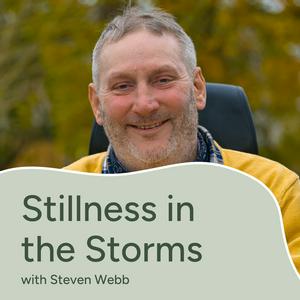
Over Stillness in the Storms
This is a podcast for anyone going through something hard.
No quick fixes. No everything happens for a reason. No advice from a man who has never had a bad week.
I am Steven Webb. In 1991, aged 18, I dived into a swimming pool in Truro and broke my neck. I have been paralysed from the chest down ever since. That is not the hard part of the story. It took another twenty two years, a bankruptcy, a spell homeless and a dark night at forty before I found anything that actually helped.
What helped was Zen. Not the serene kind with the robes and the incense. The kind you do at three in the morning when your head will not shut up and there is nobody to ring.
Every week I sit down and talk honestly about one thing. Anger, grief, pain, the mind that will not be quiet, the exhausting business of pretending you are fine. Sometimes there is an answer. Often there is just company, which turns out to be most of what people needed anyway.
Around sixteen minutes an episode. Nothing to sign up for.
Steven Webb is a meditation teacher, a Cornwall councillor and the former Mayor of Truro. He teaches from the mess, not from the mountaintop.
Podcast websiteLuister naar Stillness in the Storms, The Shawn Ryan Show en vele andere podcasts van over de hele wereld met de radio.net-app
Ontvang de gratis radio.net app
- Zenders en podcasts om te bookmarken
- Streamen via Wi-Fi of Bluetooth
- Ondersteunt Carplay & Android Auto
- Veel andere app-functies
Ontvang de gratis radio.net app
- Zenders en podcasts om te bookmarken
- Streamen via Wi-Fi of Bluetooth
- Ondersteunt Carplay & Android Auto
- Veel andere app-functies

Stillness in the Storms
Scan de code,
download de app,
luisteren.
download de app,
luisteren.
Stillness in the Storms: Podcasts in familie
 Netherlands